
You hear wilderness silence because remote parks lack roads, development, and human activity, so anthropogenic noise drops to almost nothing, letting natural sounds dominate. At night, wind subsides and terrain features—hills, valleys, and temperature inversions—create acoustic shadows that further dampen any remaining noise. Instruments at sites like Great Sand Dunes and Haleakalā record sub‑20 dB levels, allowing even a simple whistle to travel far. If you keep exploring, you’ll uncover more about the acoustic factors and policies that preserve this quiet.
TLDR
- Remote wilderness lacks roads, development, and human activity, eliminating most anthropogenic noise sources.
- Natural sounds (biophony and geophony) dominate, and without human noise they remain at sub‑20 dB levels, especially at night.
- Terrain features (hills, valleys, ridges) create acoustic shadows and focus or disperse sound, often reducing ambient levels.
- Temperature inversions and upwind gusts bend sound waves upward, further diminishing perceived noise.
- Low‑frequency natural sounds travel farther in quiet conditions, making even simple noises like a whistle audible over long distances.
Why Remote Parks Often Record Ambient Sound Below 20 dB?
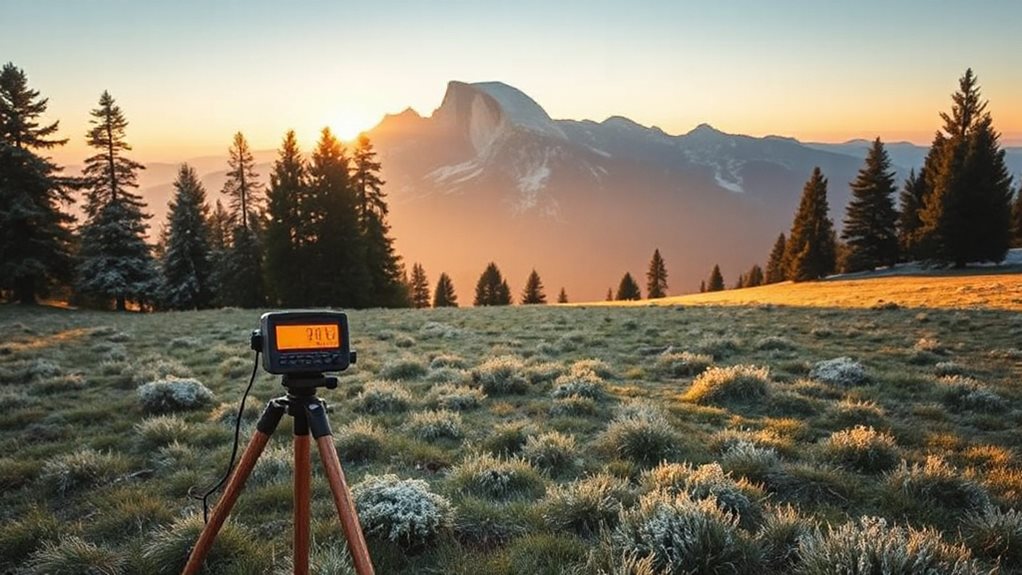
Why do remote parks often record ambient sound below 20 dB? You’ll find it’s because these places lack roads, development, and human activity, so natural sounds dominate.
Instruments at Great Sand Dunes and Haleakalā fell beneath detection limits, confirming sub‑20 dB levels, especially between midnight and six a.m. A simple whistle can still carry over a mile in such quiet conditions, making loud sounds useful for signaling in wilderness settings.
Wilderness areas preserve near‑natural acoustic conditions, offering solitude and true silence. Human‑caused noise has been shown to double sound energy in many protected areas, highlighting the rarity of such quiet.
How Park Policies Keep Human‑Generated Ambient Sound Under 55 dB(A)?
You’ll notice that parks deploy calibrated noise‑level equipment to continuously log sound pressure, so any activity that pushes the reading above 55 dB(A) triggers an alert. When the data show a breach, r quickly enforce the decibel limits set by Director’s Order #47 and 36 CFR §2.12, requiring operators to shut down or modify equipment.
This systematic monitoring and enforcement keep human‑generated ambient sound well within the EPA‑recommended 55 dB(A) ceiling, preserving the natural soundscape. Hunting is also managed through state wildlife regulations to reduce noise and protect ecosystems.
Noise‑Level Equipment
How do park managers keep human‑generated ambient sound below 55 dB(A)? You’ll see quiet‑technology guidelines that favor battery‑powered string trimmers, electric or reel mowers, and low‑dBA generators placed three meters away.
Handsaws replace chainsaws, solar‑charged EcoFlow stations power tools, and noise‑sensitive equipment stays out of core zones.
Custom $50 sound monitors, 3D‑printed sensors, and long‑term Larson Davis studies verify compliance, ensuring natural freedom remains undisturbed.
Enforcement of Decibel Limits
Quiet‑technology guidelines set the stage, but enforcement turns those recommendations into measurable results. You’ll find park managers first measuring baseline acoustics, then comparing every engine roar, snowmobile whine, or amplified speaker to the 55 dB(A) ceiling. Federal limits—75 dB(A) for vessels, 78 dB for snowmobiles—guide actions; staff patrol, log decibel readings, and issue warnings or fines, ensuring natural soundscapes stay protected while you still enjoy unrestricted freedom.
What Exactly Is “Ambient Sound” in Wilderness Monitoring?
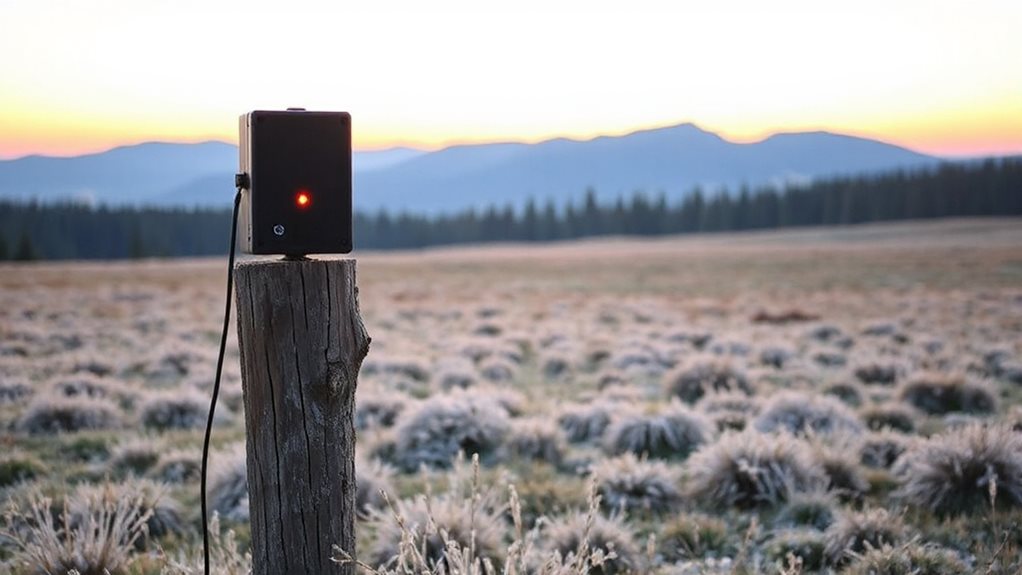
You’ll hear that ambient sound in wilderness monitoring is the background acoustic field that includes natural biophony, geophony and any distant anthropophony, measured across standard frequency bands from low‑frequency wind rumble up to mid‑range animal calls.
Your sensors record continuous 1‑second Leq levels and 1/3‑octave spectra, so you can separate true ambient energy from wind‑induced spikes that would otherwise skew the data.
Always test and calibrate your sensors at home to catch setup issues like leaks or wind interference before you deploy them in the field, especially when monitoring in areas prone to rapid weather changes and wind exposure.
Intrinsic Ambient Sound Definition
What exactly is “ambient sound” in wilderness monitoring? It’s the continuous background acoustic environment, the median level you’d hear without any human noise, comprising biophony, geophony, and anthrophony. You gauge it with Lnat, which sets a natural baseline. This baseline determines the minimum amplitude for detection, affecting wildlife communication, solitude, and the wilderness character you cherish.
Measurement Frequency Bands
Your baseline ambient sound, defined by the median Leq level, is just the starting point; to really understand what’s happening in a wilderness soundscape you need to break that background into its constituent frequency bands. You’ll use unweighted one‑third octave bands from 20 Hz up to 20 kHz, capture granular spectra, identify sources, and compare against human‑weighted A‑scale data, all with calibrated meters and 44.1 kHz recordings.
Impact of Wind Noise
How does wind shape what we call “ambient sound” in wilderness monitoring? You’ll hear clipped rustles as wind brushes foliage, creating a baseline noise that can mask wildlife calls. Strong breezes raise decibel levels, sometimes exceeding 55 dB(A), and dominate recordings. By measuring this ambient sound, you can flag windy periods, apply denoising, or use wind screens to preserve clean, useful data.
How Researchers Separate Natural Ambient Sound From Human‑Generated Noise?
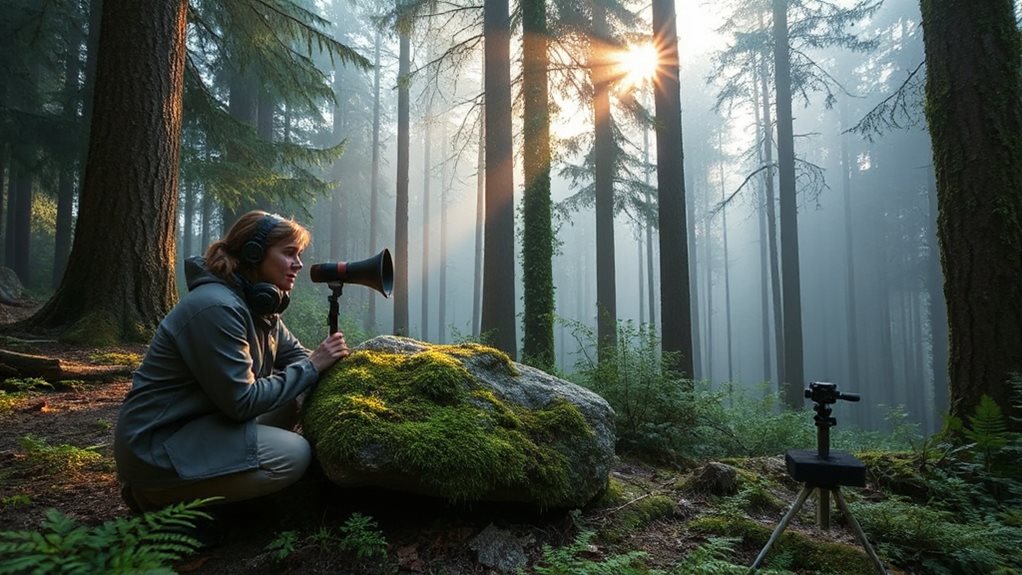
Why do researchers spend months in the field, setting up microphones and logging wind data, before they can even start teasing apart a bird’s song from a distant highway? You’ll place random‑incidence mics on tripods, log wind with anemometers, then filter recordings using porous windscreens and calibrators. By computing one‑third octave spectra, applying geospatial models, and subtracting baseline LAmin values, you isolate natural ambient from human‑generated noise. They also routinely check and fine‑tune equipment, ensuring proper cable tension and alignment to prevent poor shifting of signals.
Which Instruments Capture Ultra‑Low Ambient SPLS With 1/3‑Octave Precision?
You’ll find that precision‑grade 1/3‑octave meters, such as the SV 973A or Larson Davis 831C‑LOWN, give you reliable SPL readings even at the quietest thresholds, while low‑noise wind‑screen microphones—GRAS 40HF, Roga MMS 214, or SVANTEK’s dual‑MEMS units—capture the subtle ambient sounds without adding hiss.
Pairing these meters with wind‑screen mics lets you isolate ultra‑low SPLs in the field, maintaining the required octave resolution for accurate analysis. This combination is essential for any study that needs both sensitivity and spectral precision in wilderness silence measurements. Investing in high‑quality equipment like precision scopes can markedly improve measurement reliability in challenging field conditions.
Precision‑Grade 1/3‑Octave Meters
Ever wondered which sound meters can reliably capture ultra‑low ambient SPLs while still providing true 1/3‑octave precision? The Optimus CR170C, with its <18 dB(A) noise floor and simultaneous 1/3‑octave filters, delivers class‑1 accuracy; Scarlet Tech’s ST‑12D/ST‑15D add optional 1/3‑octave analysis and data logging; Crysound CRY2851 offers comprehensive FFT, Lp and Leq metrics; PCE, Rion, SVANTEK, Larson Davis and Optimus WPK171C kits round out the field, each supporting class‑1/2 standards, weighting options, and real‑time spectra storage for precise wilderness monitoring.
Low‑Noise Wind‑Screen Microphones
After reviewing the precision‑grade 1/3‑octave meters, the next piece of the puzzle is the microphone that lets those meters capture the faintest ambient sounds without wind interference. Choose a foam windscreen for indoor work, gaining 15‑20 dB attenuation, or upgrade to a blimp with faux‑fur for up to 50 dB reduction outdoors. Pair it with low‑self‑noise mics like Neumann TLM 102, and you’ll hear true wilderness silence.
How Wind and Topography Influence Ambient Noise Propagation Distances?

How do wind and topography shape the distance ambient noise travels? You’ll notice downwind breezes speed sound, refracting it toward the ground, so it reaches farther, especially at low frequencies, while upwind gusts lift waves upward, creating quiet shadow zones.
Hills, valleys, and ridges can focus or disperse sound, and temperature inversions in mountainous terrain bend waves downward, extending their reach.
Why Animals Need a Quiet Background to Spot 12 dB Increments?
Why do animals need a quiet backdrop to detect a 12 dB increase? In a silent setting, their auditory system can compare incoming sounds directly against a low noise floor, so even a modest rise stands out.
When background chatter masks frequencies, the same increment blends in, reducing detection chance.
Accordingly, a calm environment sharpens their sense, letting them spot subtle changes that signal prey, predators, or mates.
How Seasonal Changes Alter the Spectral Profile of Wilderness Ambient Sound?
What shifts in temperature, daylight, and animal behavior do to the soundscape?
Summer lifts ambient SPL, especially 800‑2,500 Hz, with fish choruses and midshipman hums filling dusk;
winter drops overall levels but enhances low‑frequency whale calls and decidecade peaks below 80 Hz.
Spring introduces sei‑whale bursts and early fish choruses, while autumn steadies mid‑frequency noise and sustains minke activity, reshaping spectral balance throughout the year.
What Does the ANSI Type 1 Standard Require for Accurate Ambient‑Sound SPL Measurements?
Ever wondered what the ANSI Type 1 standard actually demands for precise ambient‑sound SPL measurements? You must use a Class 1 meter covering 16 Hz–20 kHz, keep tolerance within ±1 dB, and operate under quiescent indoor or suitably calm outdoor conditions. Follow the general or precision procedure, apply A‑weighting or time‑averaged Leq‑1‑h calculations, and exclude impulsive or non‑air sounds.
How Calibration Tones Ensure Consistent Ambient SPL Readings Across Sites?
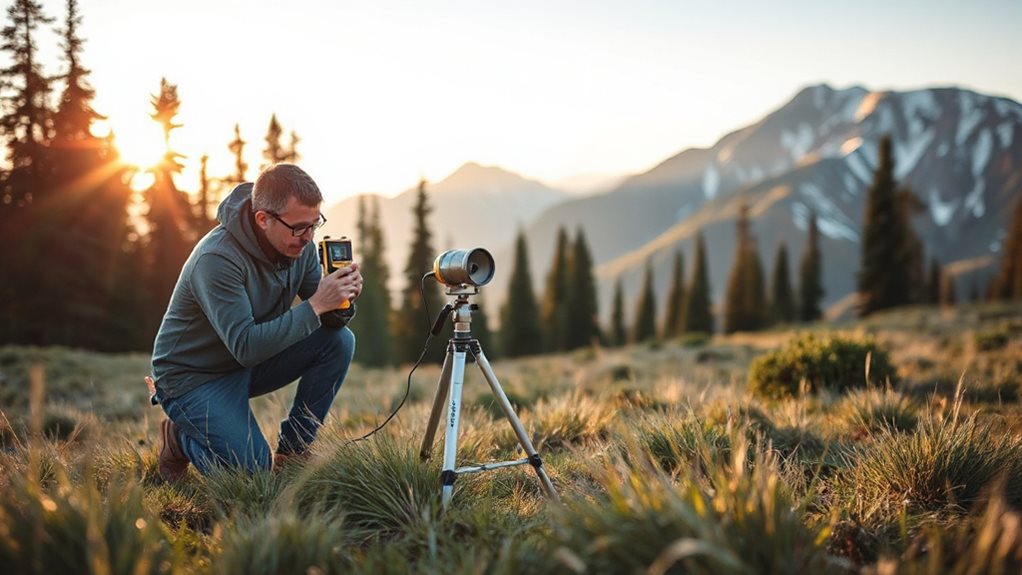
When you set up a sound‑level meter at a new location, a calibration tone is the first step that guarantees your ambient SPL readings will line up with those taken elsewhere.
You place the mic and calibrator together, emit a 1 kHz, 94 dB tone, read the display, and adjust if needed.
This standardizes measurements, compensates for temperature or humidity, and ensures every site reports comparable, trustworthy decibel values.
Why Long‑Term Ambient‑Sound Monitoring Is Challenged by Power and Weather Constraints?
How do power and weather together limit long‑term ambient‑sound monitoring? You need solar panels and rechargeable batteries, but limited capacity forces intermittent recording, especially when wind or rain drown the signal.
Extreme weather can damage ARUs, while storage and processing demand massive energy. Consequently, you balance data fidelity against power constraints, and weather‑induced noise keeps you from capturing pristine, continuous soundscapes.
Final Note
You’ve seen how remote parks stay under 20 dB thanks to natural terrain, low human activity, and strict noise policies that cap anthropogenic sounds at 55 dB(A). Ambient sound is the combined background of wind, insects, and distant water, while researchers isolate it using directional microphones and spectral filters. High‑precision 1/3‑octave analyzers, calibrated to ANSI Type 1, capture these low levels, and seasonal shifts reshape the spectrum. Long‑term monitoring remains tough because power and weather demand robust, low‑maintenance setups.


