
Mountain air is thinner because gravity pulls most of the atmosphere toward sea level, so as you climb the weight of air above you drops, lowering both pressure and density; fewer molecules per cubic meter means each breath contains less oxygen, even though the mix stays at 21 % O₂, and the reduced pressure also causes the air to expand and cool, which further lowers temperature and lift. This combination of lower pressure, reduced density, and cooler air explains why you feel the thinness, and if you keep going you’ll discover more about its physiological impacts.
TLDR
- Gravity pulls air molecules toward Earth’s surface, so at higher elevations fewer molecules occupy each breath.
- Atmospheric pressure drops with altitude because there is less air weight above, reducing molecule density.
- Rising air expands and cools adiabatically, lowering temperature and further decreasing density.
- The partial pressure of oxygen falls proportionally with total pressure, so less O₂ is available for respiration.
- Reduced oxygen pressure triggers physiological responses like hyperventilation and increased heart rate.
Gravity, Spin, and Why Mountain Air Is Thin
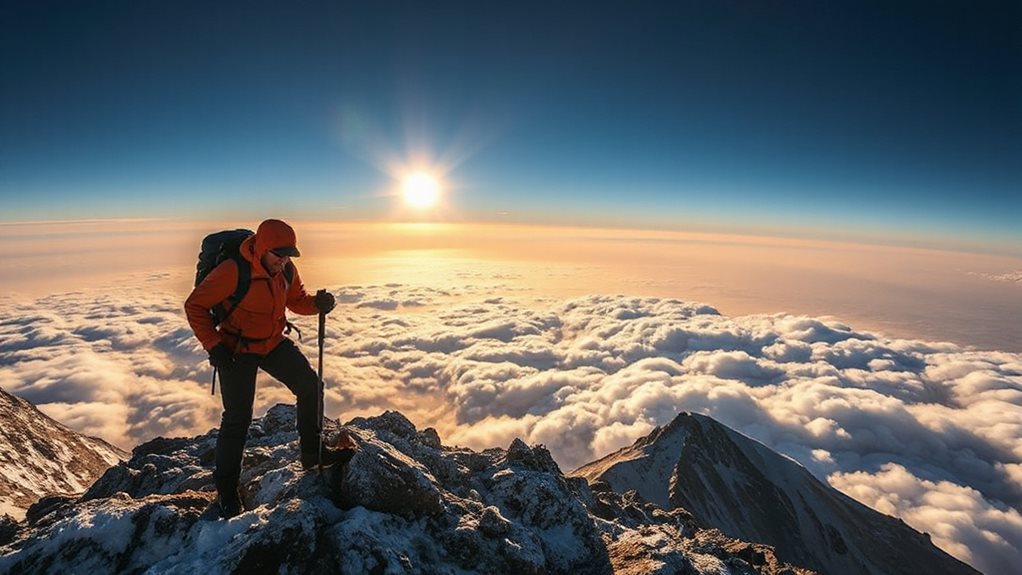
Why does the air feel thinner as you climb a mountain? Gravity pulls air molecules toward Earth, concentrating them at lower elevations, so each breath at higher altitudes contains fewer molecules. The planet’s spin adds only a negligible centrifugal lift, while the Coriolis effect reshapes wind patterns without changing density. Consequently, the higher you go, the less oxygen you inhale, despite the same 21 % concentration. The partial pressure of oxygen drops dramatically with altitude PO₂ decline. Horses and other large, less maneuverable users are given priority on trails to preserve safety and trail integrity.
How Thin Air at Altitude Reduces Pressure and Density
You’ll notice that as you climb, the air pressure drops fast because there’s less weight of atmosphere above you, and that reduction in pressure means the molecules spread out, so the density decreases sharply.
At the summit of Everest the pressure is only about one‑third of sea‑level, which translates to far fewer air particles per cubic meter.
This combination of lower pressure and thinner air is why breathing becomes harder the higher you go.
Using quality components in your gear can make high-altitude activities safer and more effective.
Pressure Drops Fast
Ever wondered why the air feels so light when you climb a mountain? As you ascend, fewer air molecules sit above you, so their collective weight drops sharply. At 5,000 ft pressure is already 84 % of sea‑level, and by Everest’s summit it’s just one‑third. Temperature lapses and seasonal shifts tweak the curve, but the pressure fall remains rapid, demanding proper preparation.
Density Decreases Sharply
When the pressure drops fast as you climb, the air’s density follows suit, and it does so dramatically. Fewer molecules per cubic foot means lift, thrust and power shrink, so your aircraft or muscles need more effort.
Warm temps and humidity push density altitude higher, thinning the air further, while at 18,000 ft it’s roughly half sea‑level density, demanding higher speeds for the same performance.
Temperature Lapse: Why Thin Air at Altitude Gets Colder
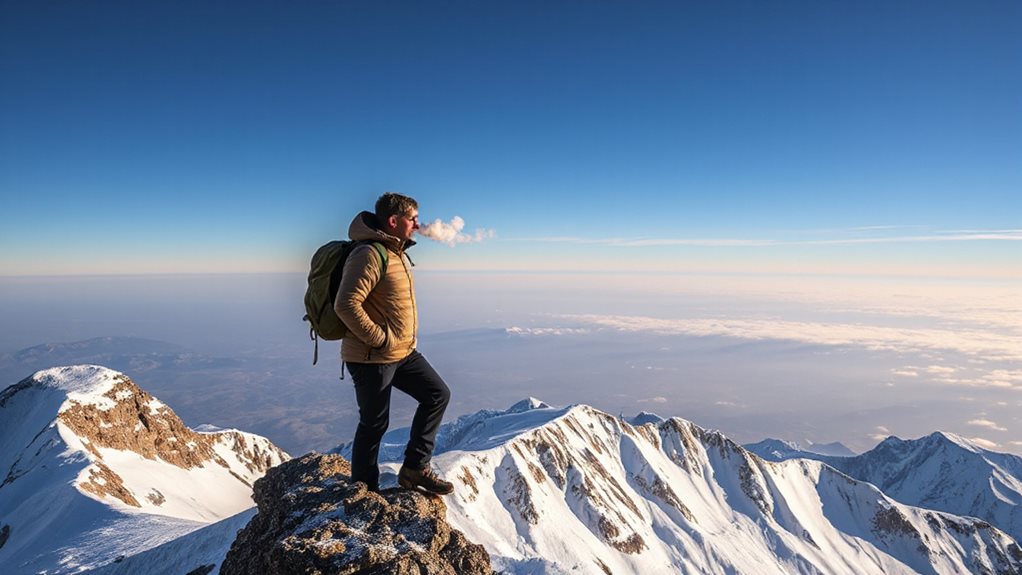
When you climb, the air expands and cools adiabatically, so its molecules lose kinetic energy and the temperature drops.
This cooling follows the lapse rate, which typically reduces temperature by about 6.5 °C per kilometer, amplifying the chill you feel higher up.
As a result, the thinner air at altitude is noticeably colder than at sea level.
Adiabatic Cooling of Rising Air
The air around you cools as it rises because it expands without gaining heat, a process we call adiabatic cooling. As pressure drops, your air parcel stretches, doing work on the surrounding air, losing internal energy, and its temperature falls roughly 9.8 °C per kilometer if dry.
Moisture slows this to 4–9 °C per kilometer, because condensation releases latent heat, moderating the chill.
Reduced Molecular Kinetic Energy
Why does the air feel colder as you climb a mountain?
At higher altitudes the average kinetic energy of gas molecules drops because temperature, measured in Kelvin, directly scales with that energy.
Fewer molecules mean less motion, so each particle moves slower, reducing heat transfer.
The thinner air therefore carries less thermal energy, making the environment feel noticeably cooler.
Lapse Rate Amplifies Temperature Drop
Ever wondered why the temperature drops so sharply as you ascend a mountain? You feel the lapse rate in action: for each thousand feet you climb, the environment typically loses 3.5–5 °F, while dry air can shed about 5.4 °F per thousand feet because it expands and cools without gaining heat.
Moist air cools slower, releasing latent heat, yet the gradient still drives colder, thinner mountain air.
What Climbers Need to Know About Pressure Altitude
Ever wondered how the numbers on your altimeter translate into the actual breathing challenge you’ll face on a summit? Pressure altitude tells you the height where the standard pressure (29.92 inHg) matches the air you’re inhaling, not the true elevation. Set your altimeter to 29.92, calculate PA = elevation + 1000 × (29.92 – setting), and gauge how thin the air feels, especially on warm days when pressure drops. You can also use simple outdoor navigation tricks like the shadow-stick method to orient yourself when visibility is poor.
Physiological Effects of Thin Air at Altitude
How does thin air actually affect your body when you climb higher? Your arterial oxygen drops, prompting hyperventilation that boosts minute ventilation from five to fifteen liters per minute, yet causes respiratory alkalosis. Your heart pumps faster, lungs constrict, and pulmonary pressure rises, while kidneys shed bicarbonate to maintain breathing. Red plasma volume and erythropoietin surge, increasing red cells, 2,3‑BPG, and cerebral blood flow, which can trigger headaches and mild altitude sickness. Cushioning choices like stack height and foam types also influence comfort and injury risk during high‑altitude trail runs.
Tips for Trekking in Thin Mountain Air
When you reach higher elevations, the thinner air that strained your oxygen intake also demands a different approach to staying safe and comfortable on the trail. Acclimatize three days before, rest often, and recognize early headache or dizziness. Wear a layered system—base, mid, shell—to handle 6‑7 °C drops per 1,000 m. Sip water and electrolytes every 10 minutes, eat carbs hourly, avoid alcohol and caffeine. Use microspikes, sturdy boots, trekking poles, and maps; pace descent, take 15‑minute breaks, and return before dark. Verify electrical gear polarity with a multimeter to ensure safe operation of heated clothing and battery-powered devices test polarity.
Final Note
You’ve learned why mountain air is thinner—gravity pulls fewer molecules upward, the lower pressure drops density, and the temperature lapse cools the air. This reduced pressure means less oxygen per breath, so your body works harder to acclimatize. When you plan a trek, account for pressure altitude, stay hydrated, ascend gradually, and recognize early signs of altitude sickness. By respecting these facts, you’ll enjoy the summit safely and comfortably.


