
You see distant mountains turn blue because the long air column between you and the peaks scatters short‑wavelength light—especially blue—far more efficiently than reds or yellows, a process called Rayleigh scattering. Nitrogen molecules and tiny particles, plus vapors from vegetation like eucalyptus oil, repeatedly redirect blue photons, while longer wavelengths pass through, giving the haze a subtle blue tint that our eyes perceive more readily than violet. The effect deepens with distance, and if you keep exploring you’ll discover even more details.
TLDR
- Rayleigh scattering preferentially redirects short‑wavelength (blue) light from the sun, giving distant objects a blue tint.
- The longer atmospheric path to far mountains increases scattering, so reds and yellows are filtered out more than blues.
- Volatile organic compounds from vegetation (e.g., isoprene) form fine aerosols that enhance blue‑wavelength scattering.
- Human eyes are more sensitive to blue than violet, and sunlight contains less violet, so the haze appears blue.
- Clear, dry air and high altitude amplify the effect, while humidity or pollutants can mute or alter the hue.
Is Rayleigh Scattering the Real Reason Mountains Look Blue?
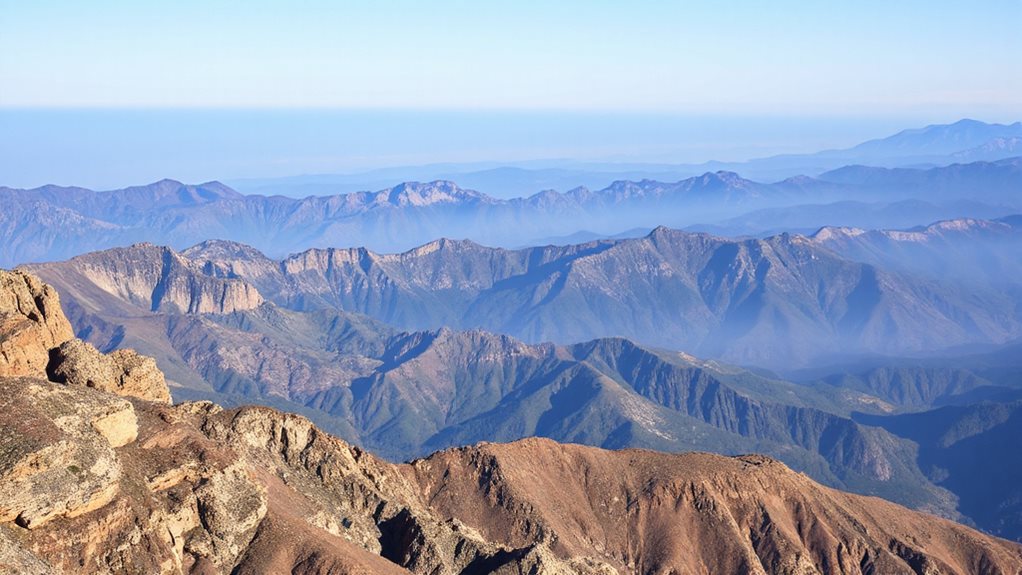
Why does a distant range of mountains often appear blue? You see it because Rayleigh scattering redirects short‑wavelength light—especially blue—more than longer colors.
Nitrogen molecules and tiny particles scatter blue photons repeatedly over tens of kilometers, while reds and yellows slip through. The cumulative effect of this elastic scattering, amplified by atmospheric depth, gives far‑off peaks their classic sapphire hue. This effect is enhanced by eucalyptus oil droplets that further increase scattering of short wavelengths. High-altitude air and the greater distance of the atmosphere between observer and mountains also increase barometric pressure differences that affect how light is scattered.
How Does Atmospheric Perspective Give Distant Peaks Their Classic Blue‑Mountains Silhouette?
Do you ever wonder why distant mountain ranges seem to melt into a soft, blue‑gray veil? Atmospheric perspective adds a thin blue filter as the air column lengthens, scattering shorter wavelengths and dimming reds.
The farther the peaks, the more air they traverse, so their silhouettes adopt cooler, paler hues that blend with the horizon, creating the classic layered, watercolor‑like mountain silhouette. Planning ahead for activities in these areas helps visitors minimize impact on fragile alpine environments and preserves those views for future generations by encouraging practices like packing out trash and staying on durable surfaces; see Camp on Durable Surfaces for guidance.
Why Does Human Vision Perceive Blue Over Violet in Mountain Haze?
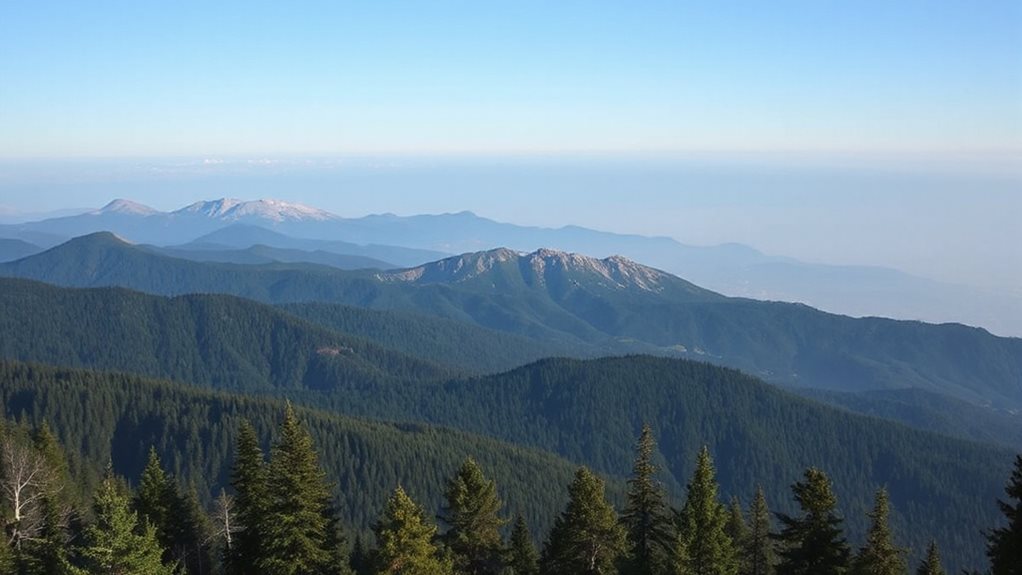
Ever notice how the distant mountains look blue rather than violet, even though violet light actually scatters more? Your eyes favor blue because retinal cones are more sensitive to those wavelengths, while violet photons hit fewer receptors. Sunlight also supplies less violet than blue, so the scattered mix leans toward blue.
Together, atmospheric scattering and human sensitivity combine, making haze appear blue, not violet.
What Amount of Air Between Viewer and Peak Shifts Color?
You’ll notice that the farther you stand from a peak, the more air the light must travel through, and that extra atmospheric path length enhances Rayleigh scattering, especially for short‑wavelength blue light.
As the distance grows from about 70 km to several hundred kilometers, the scattering intensity gradient shifts the mountain’s hue from deep blue toward a paler, almost sky‑colored tint, overwriting its true colors.
This distance‑dependent color shift means that even modest changes in the amount of air between you and the summit can dramatically alter what you see.
Store gear in a cool, dry spot and keep it clean and dry before storing to prevent moisture and material breakdown, which helps preserve colors and surface appearance over long periods; see more on clean and dry.
Atmospheric Path Length
How much air you’re looking through determines whether a distant peak appears crisp or takes on a blue hue. As the distance grows, Rayleigh scattering increasingly removes longer wavelengths, letting blue photons dominate. By 5–10 km the mountain’s texture fades, turning deep blue; beyond 20 km it matches the pale horizon. Your eyes sense this shift when scattered blue light overwhelms the original colors.
Scattering Intensity Gradient
When you look at a mountain far away, the amount of air between you and the peak determines how much its color shifts toward blue. More air means more Rayleigh scattering of short wavelengths, so blue light dominates the reflected glow.
As distance increases, scattering intensity rises proportionally, creating a smooth gradient that subtly deepens the mountain’s hue, especially under clear skies.
Distance‑Dependent Color Shift
So much air sits between you and a distant peak, the more its hue drifts toward blue, because each additional layer of atmosphere adds Rayleigh scattering that preferentially redirects short‑wavelength light.
As distance grows, more molecules intercept the light, amplifying the blue shift; clear skies let this effect shine, while humidity or particles can mute or elevate it, letting you gauge depth by color alone.
How Do Isoprene Emissions Strengthen the Blue Haze of the Blue Ridge?
When temperatures rise, you’ll notice that trees in the Blue Ridge pump out isoprene at their peak, turning the forest into a massive source of volatile organic compounds. Those VOCs quickly combine with ozone and other gases, forming tiny aerosol particles that scatter sunlight, especially the shorter blue wavelengths. This enhanced Rayleigh scattering gives the distant mountains their characteristic blue haze, making the view both vivid and scientifically fascinating. Sleeping on cold ground without insulation can accelerate heat loss, increasing hypothermia risk from ground contact and underscoring the need to stay dry and insulated with a sleeping pad.
Isoprene Release Peaks
Ever wonder why the Blue Ridge turns that vivid, almost surreal teal on scorching summer days? You’ll see isoprene spikes when temperatures hit 38‑42 °C, especially on hot, stressed oaks and poplars. The enzyme isoprene synthase fires up, releasing volatile hydrocarbons that quickly form aerosol mist. This mist scatters short‑wave light, enhance the blue hue you love, then eases as temperatures dip toward 30 °C.
VOC‑Driven Aerosol Formation
What makes the Blue Ridge glow with that unmistakable teal is the cascade of reactions that turn tree‑released isoprene into light‑scattering particles. In sunlight, isoprene from oaks, hickory, and conifers oxidizes with ozone and nitrogen oxides, forming secondary organic aerosols sized to scatter short, blue wavelengths. Warm days enhance emissions, so you see a vivid haze, while local tree mix and temperature dictate intensity.
Enhanced Rayleigh Scattering
How do the abundant isoprene emissions from Blue Ridge trees enhance the region’s iconic teal haze? You see, isoprene forms terpenoid aerosols that elevate Rayleigh scattering, especially for short‑wavelength blue light. These tiny particles amplify the natural scattering by oxygen and nitrogen, so the sky’s blue hue deepens.
The result: a vivid, distant‑mountain glow that feels freer and more expansive.
When Does Summer Heat Make Mountains Turn Most Blue?
When summer heat peaks, the mountains turn their bluest, especially during the mid‑summer months of June through August. You’ll notice the blue intensifies as oak‑rich forests release isoprene, a volatile compound that mixes with ozone under strong sunlight, scattering blue wavelengths.
The effect peaks when temperatures are highest, VOC concentrations surge, and the atmosphere is clear, giving you the deepest distant blue. Pinas Bay is known for the thickest concentration of marlin and offers excellent warm-water conditions Pinas Bay that contrast with mountain blue vistas.
How Do Humidity and Pollution Amplify the Distant Blue Tint?
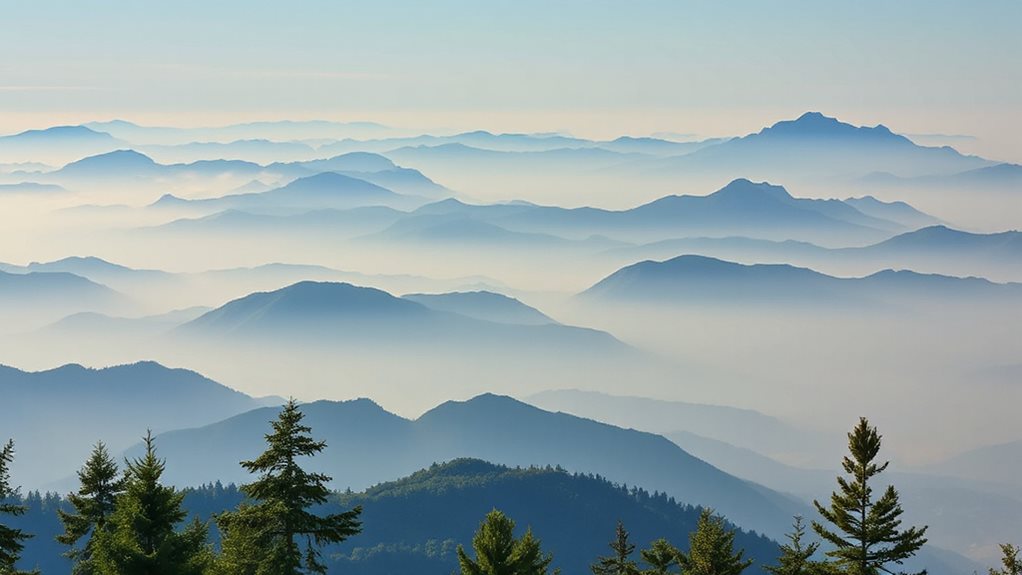
The sky‑blue veil that deepens over distant peaks in summer doesn’t come from heat alone; when the air is humid and carries pollution, the scattering processes that create the blue tint become even more pronounced.
Moisture enhances Rayleigh scattering, thickening the vapor layer so blue light accumulates, while fine pollutants add Mie scattering that preferentially redirects blue wavelengths.
Together they extend the optical path, deepening the hue and giving mountains a watercolor‑like, distant glow.
Which Global Ranges Show the Same Blue‑Mountains Effect?
You’ll notice the same sapphire haze over Australia’s Blue Mountains, where eucalyptus‑derived vapors mingle with ozone, and you’ll see a comparable glow in the Andes of South America, where high‑altitude forests release similar compounds.
Both ranges illustrate how vegetation‑driven volatile organic gases can scatter short‑wave light, giving distant peaks a distinctive blue cast.
Recognizing these parallels helps you understand that the phenomenon isn’t limited to one continent but recurs wherever the right mix of trees, altitude, and atmosphere aligns.
Blue Mountains – Australia
Ever wondered why the Blue Mountains in New South Wales appear hazy and bluish from afar? You’ll find atmospheric perspective at work: tiny water droplets and dust scatter short‑wavelength light, so distant ridges glow blue.
The name stems from this effect, and similar haze colors paint ranges across Europe, Asia, and North America, where clean air and moisture mingle.
Andes – South America
Blue mountains aren’t unique to Australia; the Andes stretch across South America and showcase the same hazy, bluish glow when you view them from a distance. You’ll notice Rayleigh scattering tinting distant peaks like Ojos del Salado, especially beyond 70 km under clear skies, while the Altiplano and arid Atacama amplify the effect. This universal blue‑mountain phenomenon mirrors other ranges worldwide.
Why Doesn’t Mars Exhibit the Same Blue‑Distance Phenomenon?
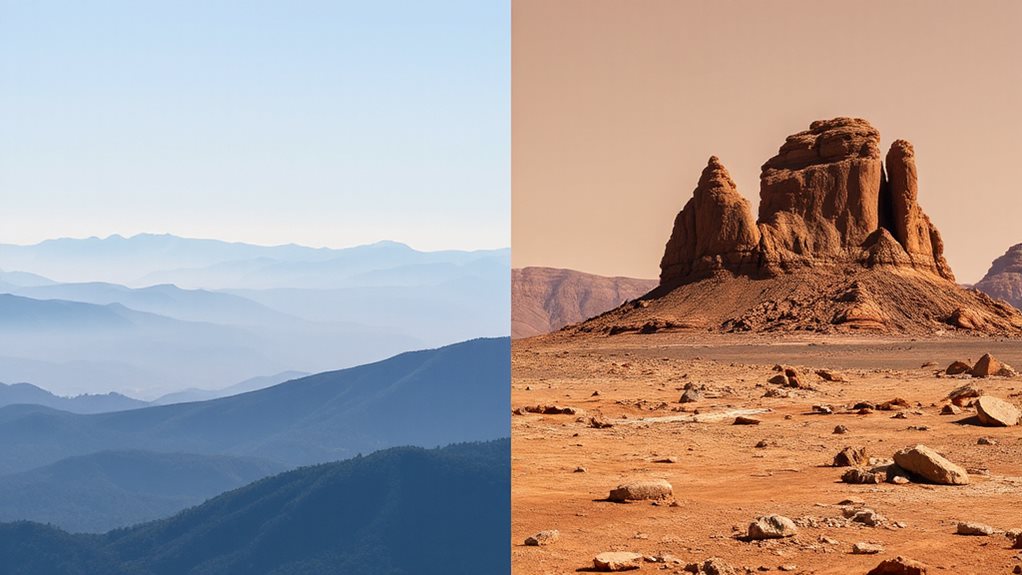
Why does Mars not show the familiar blue‑haze that makes distant Earth mountains appear bluish?
You’ll notice Mars’ atmosphere is over 99% thinner than Earth’s, so Rayleigh scattering barely occurs.
Instead, fine iron‑oxide dust dominates, scattering red light more efficiently and absorbing blue.
The result is a reddish haze, not a blue distance effect, even during dust storms.
Photographer’s Guide to Capturing Blue‑Mountains at Distance
When you stand on a cliff edge at sunrise, the distant peaks often take on a subtle blue hue, a result of atmospheric scattering that softens and blends colors over great distances.
Set white balance to cloudy, choose a high‑f aperture for depth, and raise ISO or aperture for fast shutter speeds.
Shoot during dawn or rain for mist‑lit drama, pre‑focus on the ridge, and use a telephoto to compress viewpoint, letting the blue mountains dominate the frame.
What Common Misconceptions About “Blue Mountains” Need to Be Debunked?
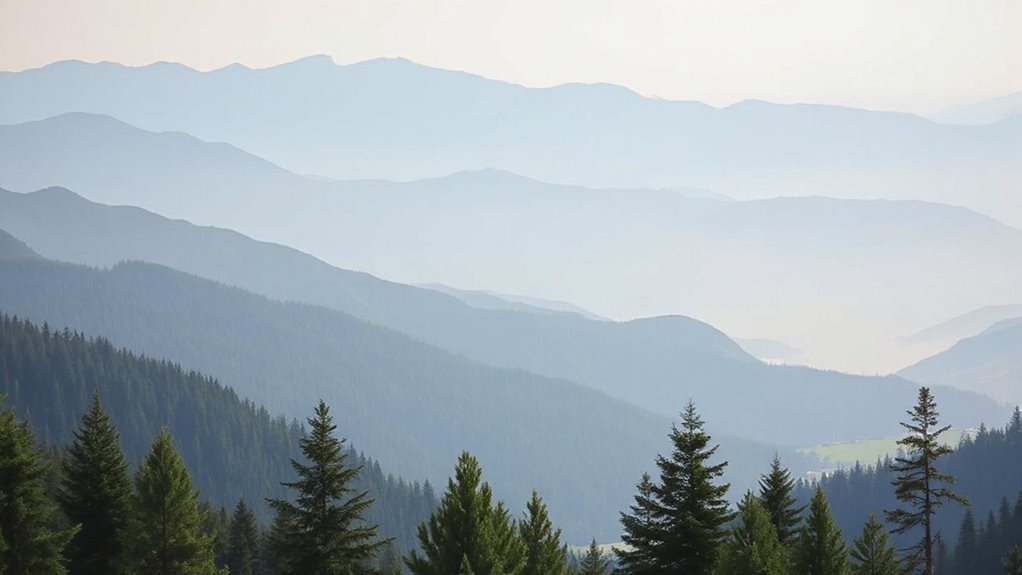
Do you ever wonder why people claim the blue hue of distant peaks comes from mystical gases or secret mountain pigments? You’ll find the myth debunked: Rayleigh scattering, not magic, bends short‑wavelength light, and distance amplifies it.
Eucalyptus oil and dust add a boost, but pollutants and humidity can dim or brighten the effect. All is physics, not folklore.
Final Note
You now see that distant mountains appear blue because the atmosphere scatters shorter wavelengths, especially blue light, through Rayleigh scattering and the haze created by pollutants like isoprene. This effect intensifies with the depth of air between you and the peak, giving the classic blue‑mountain silhouette that varies across global ranges but not on Mars, where the thin CO₂ atmosphere lacks sufficient scattering particles. Understanding these mechanisms lets you predict, photograph, and appreciate the phenomenon with confidence.


