Pick a paddle that matches your height and kayak width, then fine‑tune it for stroke style and seat height. Generally, if your kayak is under 23″ wide, aim for a 200–220 cm shaft; 23–28″ calls for 210–230 cm; 28–32″ fits 220–240 cm; and over 32″ works best at 230–250 cm. Adjust a few centimeters up if you have a high‑seat or sit‑on‑top kayak, and shorten slightly for high‑angle strokes. This balance gives you comfortable shoulder angles and solid control, and the next section shows how to apply these rules to your specific setup.
TLDR
- Choose paddle length primarily by kayak width: 200‑220 cm for <23″, 210‑230 cm for 23‑28″, 220‑240 cm for 28‑32″, 230‑250 cm for >32″.
- Adjust for paddler height: shorter paddlers (≈5′0″‑5′2″) use 188‑194 cm; average heights (5′6″‑6′0″) use 220‑230 cm; tall paddlers (>6′3″) may need 203 cm or longer.
- Match stroke style: high‑angle strokes favor slightly shorter shafts (≈215‑220 cm); low‑angle strokes benefit from longer shafts (≈220‑240 cm).
- Consider kayak type and seat height: recreational and fishing kayaks often need 230‑260 cm; touring/sea kayaks 200‑220 cm; sit‑on‑top or elevated seats push length toward 250‑260 cm.
- Test on‑water feel: a correctly sized paddle should allow comfortable reach without shoulder strain; if it feels too long or too short, fine‑tune within the recommended range.
What Paddle Length Is Right for You? – Quick Answer

On a typical day on the water, you’ll find that the width of your kayak is the single most reliable factor for picking the right paddle length.
If your boat is under 23″, aim for 200‑220 cm; 23‑28″ calls for 210‑230 cm; 28‑32″ fits 220‑240 cm; over 32″ usually needs 230‑250 cm.
Adjust a bit for seat height or stroke style, but let width guide you. For touring kayaks, consider the boat beam width when fine‑tuning your paddle length.
Also factor in how hull shape and stability affect paddling reach and efficiency by matching paddle length to your kayak’s hull characteristics.
Determine Paddle Length by Height
Your height gives you the first, reliable baseline for paddle length, so start by matching your stature to the standard charts.
Then consider your kayak’s width, because wider boats typically call for a slightly longer blade to maintain balance and power.
Finally, think about your stroke style—high‑angle paddling favors a shorter shaft, while low‑angle cruising benefits from a longer one.
Also factor in your kayak’s payload, since heavier loads affect stability and may require adjustments to paddle length for optimal control, especially on high capacity boats.
Height Height Matching
If you’re figuring out which paddle length fits you, start with your height, because most sizing charts use it as the primary reference point.
For whitewater, under 5’2” typically calls for 188–194 cm, while 5’0”–5’8” leans 191–197 cm, and over 6’3” often lands at 203 cm.
Touring charts stretch those numbers to 200–250 cm, matching longer strokes and smoother cadence.
Width Adjustments Needed
When you factor kayak width into the paddle‑length equation, the numbers shift noticeably: narrower hulls under 23 inches typically call for paddles 5–10 cm shorter than those for 28‑32‑inch boats, and widths over 32 inches often add another 10 cm to the base recommendation.
Match your height‑based length to the width band—under 23″, 23‑28″, 28‑32″, or over 32″—and add 5‑10 cm per band, remembering that raised seats or inflatable designs may need an extra 10 cm for enhanced reach and control.
Stroke Style Influence
Paddle length isn’t just a function of height; the angle at which you paddle plays a major role.
Low‑angle strokes favor longer shafts—typically 220‑230 cm for 5’6″‑6’0″ paddlers—while high‑angle strokes trim the length to about 215‑220 cm.
Match your stroke style before finalizing size; a relaxed, low‑angle style needs extra reach, whereas a steep, high‑angle style benefits from a shorter, more responsive paddle.
Determine Paddle Length by Kayak Width
Because the kayak’s width determines how far your blade must reach to touch the water, it’s the primary factor when you’re figuring out paddle length. Measure the widest point, then match it to width bands: under 23″ → 200‑220 cm, 23‑28″ → 210‑230 cm, 28‑32″ → 220‑240 cm, over 32″ → 230‑250 cm.
Adjust for your height, but let width guide the base choice. A garage-mounted pulley hoist can help store wide kayaks safely when not in use, reducing sun and rain exposure and saving floor space kayak hoist.
Pick the Right Paddle Length for Your Kayak Type
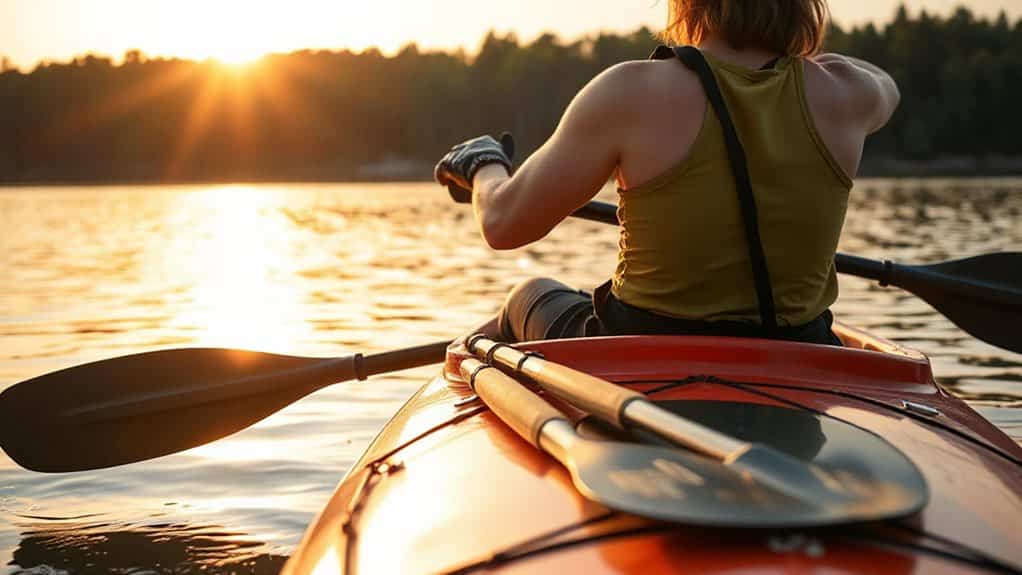
Your kayak’s purpose and design now shape the ideal paddle length, building on the width‑based guidelines you just learned.
For recreational kayaks, choose 230‑250 cm; wider hulls and elevated seats may need the longer end.
Touring models favor 200‑230 cm, with slimmer hulls leaning toward 200 cm.
Sea kayaks work best with 200‑220 cm, keeping blades low‑angle.
Fishing kayaks demand 240‑260 cm for reach, while whitewater craft use 190‑200 cm for quick, tight strokes.
Also consider your torso height and paddling style when selecting length to ensure efficient strokes and reduce fatigue, especially by focusing on core muscles for power and endurance.
Choose Paddle Length for Your Stroke Style
If you favor a relaxed, touring‑style paddle, you’ll likely lean toward a low‑angle stroke and choose a longer shaft—typically 220 cm to 240 cm—so you can keep your top hand below shoulder level and maintain a smooth, efficient pull.
Conversely, a high‑angle stroke, which is more vertical and powerful, works best with a shorter paddle around 210 cm to 215 cm, giving you a quicker cadence and less sweep.
Your decision should reflect whether you prioritize endurance and a laid‑back glide or speed and an aggressive, athletic feel.
Many paddlers choose longer paddles for scenic waterways to better enjoy relaxed touring and sightseeing.
High‑Angle Stroke Selection
Gliding through the water with a high‑angle stroke means keeping the paddle shaft almost vertical, so the blade stays close to the hull and you can maintain a quick cadence.
Choose a 205‑220 cm paddle, leaning toward the shorter end if you’re under 5’4”.
Shorter shafts keep the blade near the kayak, reduce shoulder strain, and let you recover hands fast, enhancing maneuverability and acceleration.
Low‑Angle Stroke Selection
Choosing the right paddle length for a low‑angle stroke hinges on matching the shaft to your torso and kayak width, because a longer shaft lets the blade stay flat in the water while keeping your top hand comfortably below shoulder level.
Aim for 220‑240 cm if you’re 5’6”‑6’ tall, a 32‑inch kayak; taller paddlers may need 250 cm.
Test by extending your arm: the blade should fully immerse without digging too deep, adjusting ±5 cm for perfect comfort and control.
Adjust Length for Sit‑On‑Top and Elevated‑Seat Kayaks
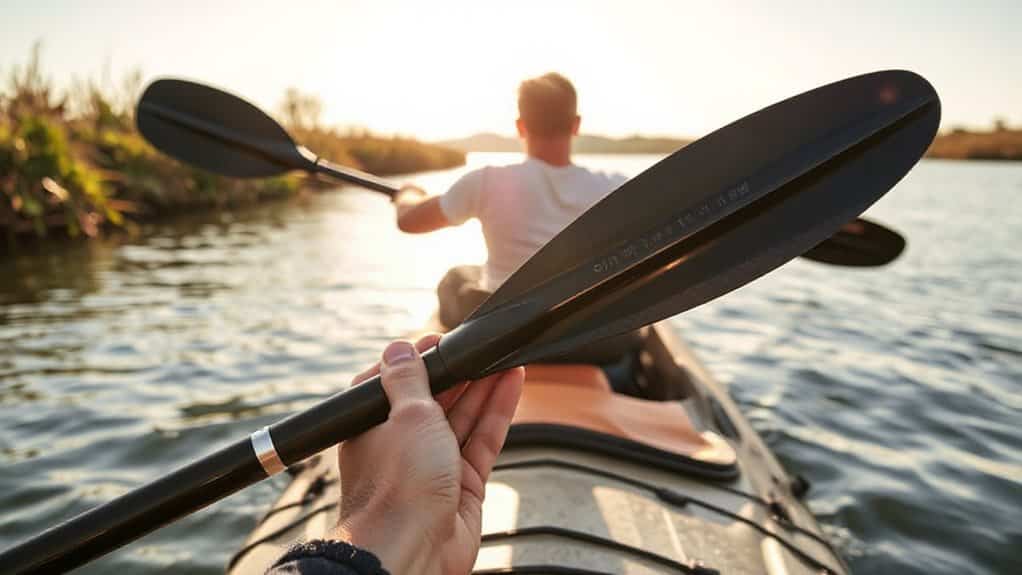
Why does seat height matter when you pick a paddle for a sit‑on‑top or raised‑seat kayak?
Higher seats push you farther from the water, so you need a longer paddle—typically 250–260 cm—to keep a comfortable stroke and proper angle.
Lower seats let you use shorter shafts, around 220–240 cm.
Adjustable‑length paddles let you fine‑tune for each position, preserving efficiency and freedom on the water.
Reference Chart: Height × Kayak Width → Paddle Length
Seat height already showed how a higher cockpit pushes you farther from the water, demanding a longer shaft to keep a comfortable stroke angle.
The reference chart matches your height with kayak width; under‑23‑inch boats pair with 200‑210 cm paddles for sub‑5‑ft paddlers, 23‑28 inch widths call for 220 cm, 28‑32 inch need 230 cm, and over‑32‑inch require 240‑250 cm.
Adjust for style or seat height as needed.
Avoid Common Mistakes When Choosing Paddle Length
Ever wondered why a paddle that feels right in the store can suddenly feel off on the water?
You’ll avoid common mistakes by matching paddle type to your stroke style, checking blade shape, and considering kayak width and seat height.
Don’t pick an oversized paddle that strains shoulders, nor a short one that crams the catch.
Remember blade length, shaft design, and feathering all affect fit, so compare actual on‑water feel, not just printed centimeters.
And Finally
Pick the paddle that matches both your height and your kayak’s width, then fine‑tune it for your stroke style and kayak type. A well‑chosen length gives you control, reduces fatigue, and keeps your paddle in the optimal angle for efficient paddling. Remember to check the reference chart, avoid common sizing mistakes, and adjust for sit‑on‑top or elevated‑seat models. With the right length, you’ll glide smoothly and stay comfortable on every trip.