Your eyes are built for twilight, with huge, horizontally elongated pupils and retinas packed with light‑sensitive rods that work best in dim light. When a car’s headlights flood the scene, those rods become saturated and the reflective tapetum lucidum, which normally gives photons a second chance, is overwhelmed, turning your night‑vision advantage into a blinding glare. The sudden, unfamiliar intensity triggers an instinctive freeze, buying you a split‑second to assess the threat before deciding whether to bolt, and if you keep going you’ll uncover more about how light and behavior interact.
TLDR
- Sudden, intense headlights overwhelm the deer’s tapetum lucidum and rods, causing temporary visual saturation and loss of contrast.
- The flash blinds the deer’s wide pupils, turning its night‑vision advantage into disorientation and a brief “freeze” to reassess.
- Deer instinctively freeze before deciding to flee, buying time to evaluate the unfamiliar threat and its speed.
- Low‑light twilight reduces depth cues, making it harder for the deer to judge the car’s distance and motion, prompting a pause.
- Individual personality (bold, shy, cautious) influences freeze duration, but the common physiological response is visual overload.
How Do Deer Eyes Adapt to Low‑Light Conditions?
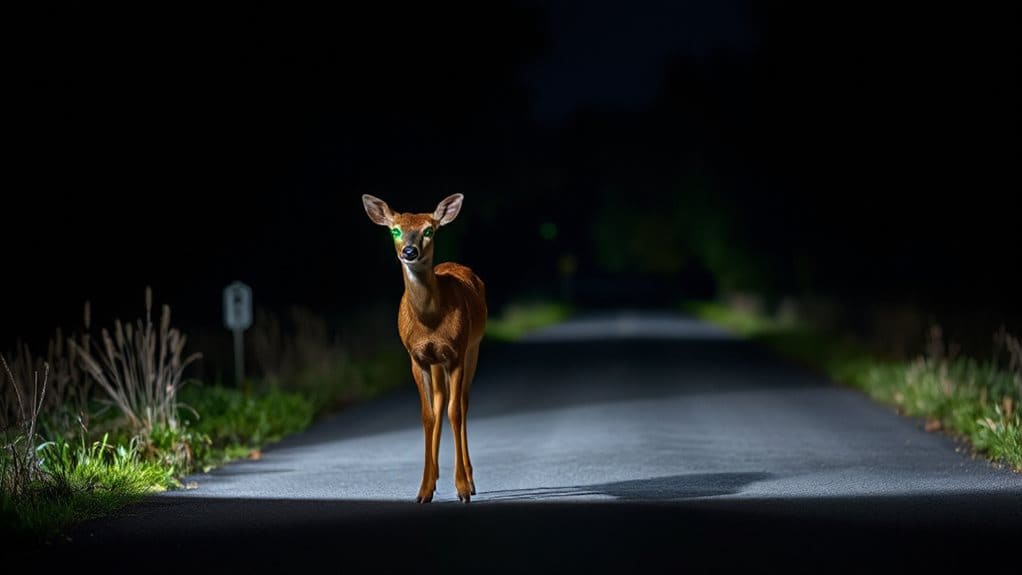
How do deer see so well at dusk and night? Your eyes notice their large, horizontally elongated pupils that dilate from 2 mm to over 8 mm, letting in a flood of light.
Their retinas are packed with rods, not cones, so they detect motion and contrast in dim light. This rod‑rich design supports excellent low‑light vision for detecting movement at twilight.
Behind the retina, the tapetum lucidum reflects unabsorbed photons, giving each photon a second chance to be sensed, enhancing sensitivity while sacrificing sharpness and color.
This design lets them roam freely after dark. Their eyes are positioned on the sides of their heads, providing a wide field of view.
Why Do Sudden Headlights Overwhelm the Tapetum Lucidum?
When a car’s headlights slam into a dark forest, the sudden flood of light overwhelms the deer’s tapetum lucidum, a reflective layer that normally enhances dim‑light vision by sending photons back through the retina.
Your eyes double the light, saturating rods, blinding contrast, and amplifying glare.
Wide pupils let in even more photons, so the deer’s night‑vision advantage flips into disorientation, forcing a brief freeze.
This freezing behavior also contributes to the high number of deer-vehicle collisions on rural roads, especially near forest edges.
Why Do Deer Freeze When Cars Zoom By?
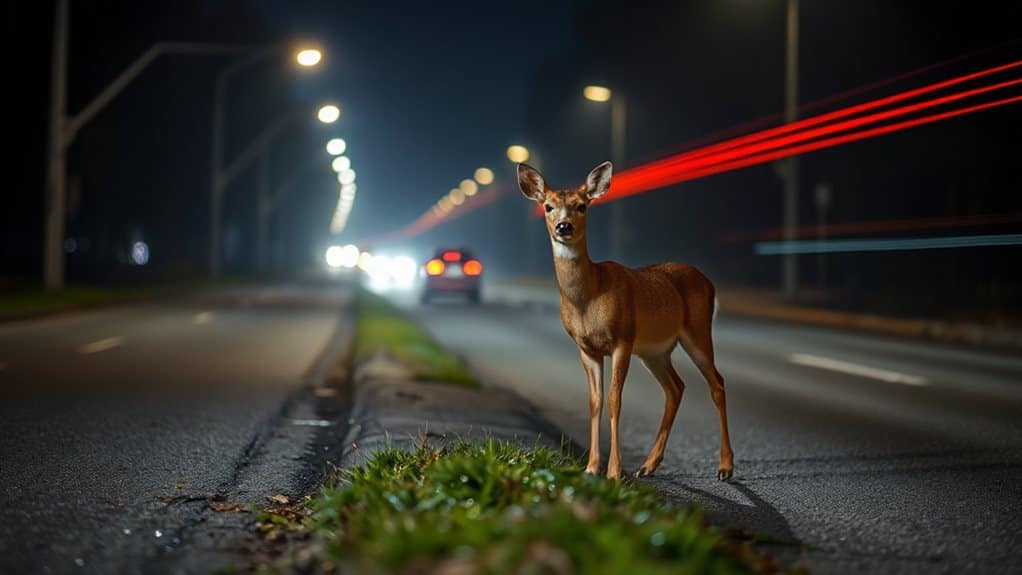
Because a car can appear out of nowhere and move faster than any natural predator, a deer’s instinctive freeze response often kicks in before it can decide whether to run.
You’ll notice that sudden glare overwhelms its vision, low‑light twilight blurs depth cues, and peripheral eyes misjudge speed, so the animal pauses, buying time to assess the unfamiliar threat before it can safely flee.
Regular practice of safe behavior and awareness—similar to how hunters are taught to follow safety rules—can reduce dangerous encounters between vehicles and wildlife.
What Light Settings Reduce Deer Freeze?
you should pair high‑brightness LED headlights with a rear‑facing LED light bar, creating a broad, looming front silhouette. This dual‑lighting expands the illuminated area, giving deer earlier visual cues, triggering flight instead of paralysis. The combination slashes dangerous encounters from 35 % to 10 %, offering you safer, freer drives. Choose lighting setups that also preserve ventilation in your vehicle to prevent fogging and maintain clear visibility.
How LED Blue Light Creates Stronger Glare Than Halogen?
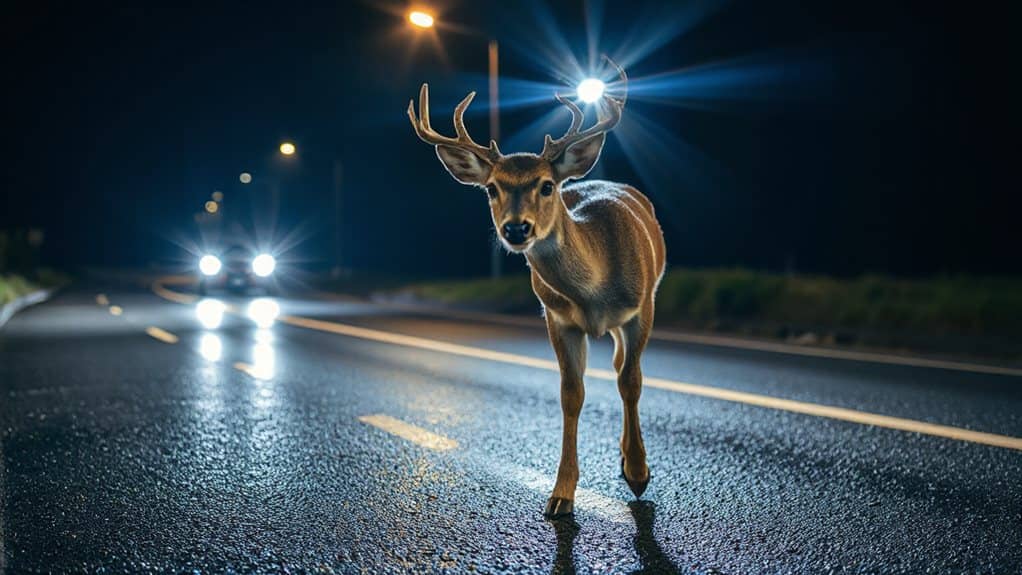
In the world of automotive lighting, LED headlights often look whiter and bluer than traditional halogen bulbs, and that shift in color temperature—typically 4,500 K to 6,000 K versus 2,700 K to 3,200 K for halogens—makes the light appear harsher and more glaring.
Blue‑rich LEDs scatter more in the eye, concentrate brightness, and often miss halogen‑designed optics, so stray light spikes glare, while halogens emit softer, warmer light that’s easier on night‑time vision.
Why Deer Must Be Within ~20 m to See a Human
The glare from blue‑rich LED headlights can make it harder for deer to pick out a stationary shape, but the real limitation isn’t the color—it’s the animal’s visual acuity.
You’ll notice deer only recognize a human within twenty meters because their 20/60‑20/100 vision blurs details beyond that range.
Their eyes favor motion detection, so a still person blends into the background, while any movement instantly catches their attention, prompting a freeze response.
Knowing basic navigation tools like a compass can help drivers and hikers avoid surprise encounters in low visibility by improving situational awareness with fast orientation.
How Lateral Eye Placement Limits Deer Depth Judgment
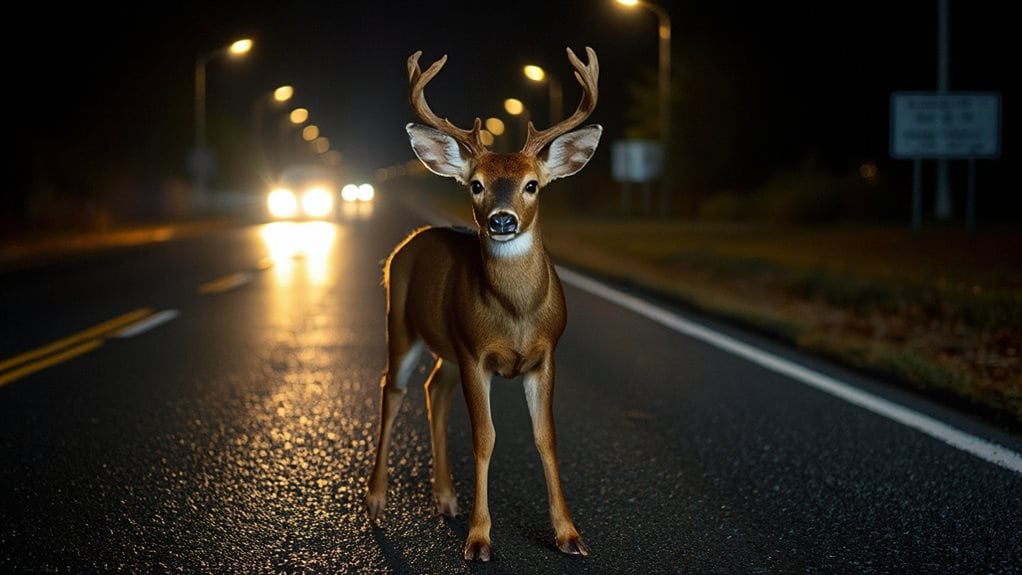
Because deer’s eyes sit on the sides of their heads, the overlap between the two visual fields is tiny, and that narrow binocular zone is what limits their depth perception.
You’ll notice their panoramic 310° view lets them spot motion on flanks instantly, but the tiny overlapping area weakens stereoscopic cues, so distance estimates become fuzzy.
Horizontal pupils scan horizons, favoring threat detection over precise range, making you’s motion more critical than exact positioning.
Do Bold, Shy, or Cautious Personalities Change Deer Responses?
When you’re driving through deer habitat, the personality of the animal you encounter can shape how it reacts to your headlights, and research shows that bold, shy, and cautious deer each follow distinct patterns.
Bold deer linger, sniff, and may bolt after a brief assessment.
Shy deer freeze longer, preferring distance.
Cautious deer scan, pause, and hold still, using the freeze to gauge danger before deciding whether to move.
What Drivers Can Do to Prevent Deer Collisions at Night
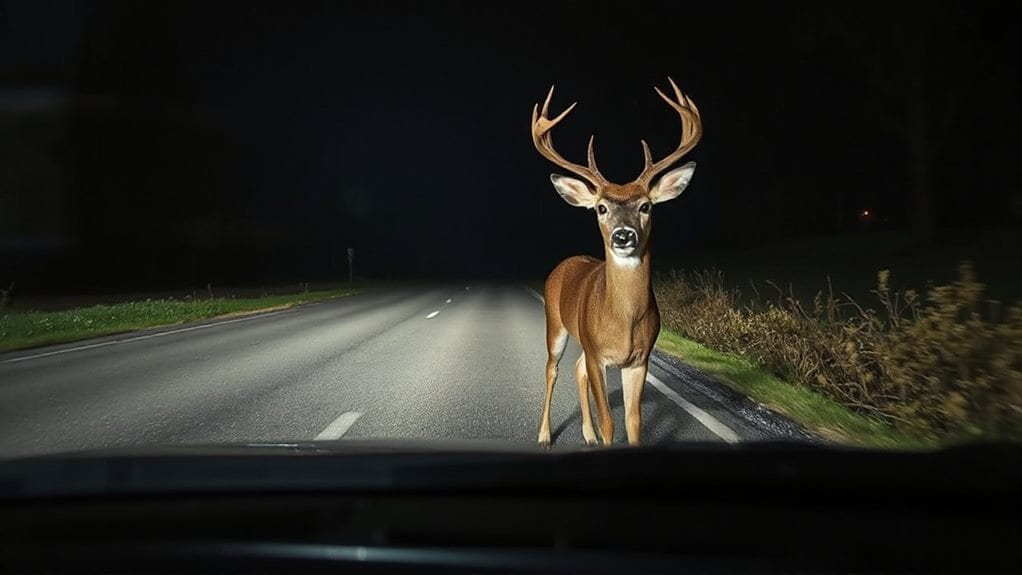
You should cut your speed when you enter wooded or rural stretches, giving yourself enough time to spot a deer and react safely.
Adding reflective markers or a rear‑facing LED bar to your vehicle makes its front surface more visible, helping deer recognize the approaching car earlier.
Together, these adjustments let you stay in control and reduce the chance of a nighttime collision.
Reduce Speed Adjustments
Typically, you’ll find that slowing down at night—especially on roads that skirt woods or fields—gives you the extra seconds needed to spot a deer’s eye shine and react before it darts across the lane.
Reduce speed modestly on two‑lane, curved, or forested routes; a ten‑mph drop can matter.
Keep headlights within illumination range, stay generous behind other cars, and brake firmly, not swerve, if a deer appears.
This measured pace preserves freedom while cutting collision risk.
Roadside Reflector Use
Slowing down gives you the chance to notice a deer’s eye shine, but the next step is to make the road itself less inviting.
Reflectors, though advertised to cut collisions 78‑90%, lack solid evidence; studies show mixed or negligible effects, and maintenance costs often outweigh benefits.
Instead, focus on speed, headlights, and heightened vigilance, which truly reduce nighttime deer encounters.
When Freezing Becomes Dangerous: Night‑Driving Safety Tips
Because headlights can freeze deer in place long enough for a car to close the distance, night‑driving safety hinges on anticipating that pause and reacting early. Slow down, dip high beams, keep extra following distance, and use a brief horn if the animal stays still.
Scan edges, stay alert on rural routes, and remember dimmer lights lessen glare, giving both you and the deer more time to move safely.
And Finally
You now know why deer freeze under headlights: their eyes, built for low‑light vision, are overwhelmed by bright, sudden beams, and their laterally placed eyes limit depth perception, causing a “stop‑and‑look” response. Using low‑intensity, yellow‑tinted lights and avoiding high‑beam flashes can reduce glare, while slowing down and staying alert gives you time to react. By applying these simple tactics, you’ll help keep both drivers and wildlife safer on night roads.