
You might think bears are clumsy, but black, Asiatic black, sun, and spectacled bears actually zip up trees at 10‑15 ft/s, scaling a 100‑foot trunk in under a minute thanks to curved claws that act like grappling hooks, powerful forelimbs, and lightweight frames. Brown and grizzly bears can climb, though they’re slower and stick to lower trunks, while polar bears rarely use trees at all. They climb for food, safety, and cub training, but a tree isn’t a guaranteed escape. Keep these facts in mind, and you’ll uncover even more details.
TLDR
- Black, Asiatic black, sun, and spectacled bears are regular climbers, scaling 100 ft in under 30 seconds using hooked claws and powerful forelimbs.
- Their curved claws act like grappling hooks, allowing rapid upward motion of roughly 10–15 ft/s.
- Brown and grizzly bears can climb, but slower and only on low, sturdy trunks due to straighter claws and heavier bodies.
- Bears climb mainly for food (berries, nuts, insects, human trash) and as an escape or observation point, not for reliable protection.
- Polar bears are virtually ground‑bound and do not use trees for climbing.
Why Are Bears Better Tree Climbers Than Most Assume?
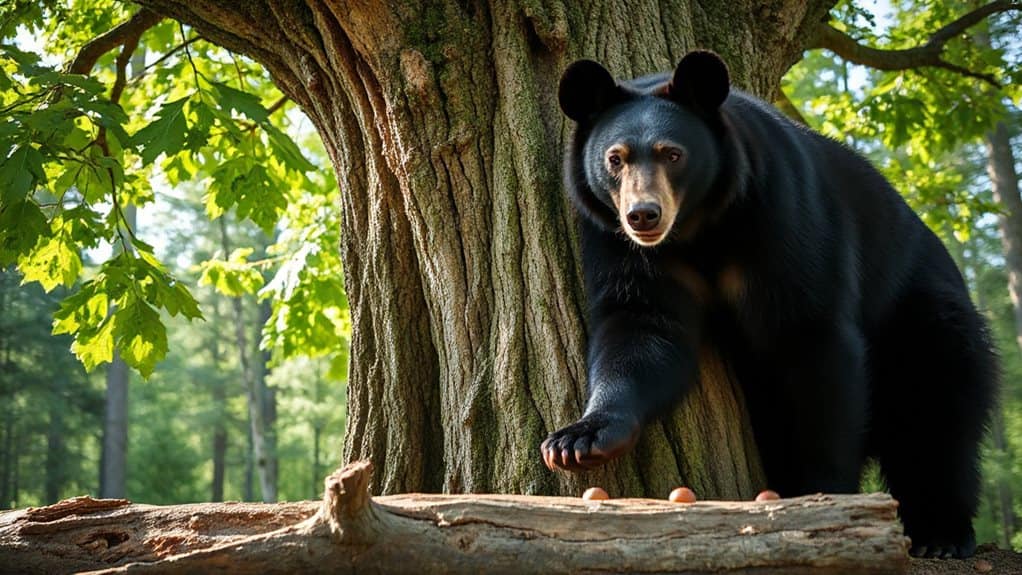
Because many people only see bears lumbering on the forest floor, they underestimate how well‑adapted these animals are for climbing. Their curiosity about freedom aligns with their natural drive: curved claws act like grappling hooks, powerful upper bodies generate vertical force, and lightweight frames enable swift ascents of 10‑15 ft/s. They climb for food, safety, and teach cubs early, maintaining skill throughout life. American black bears can scale tall trees in under 30 seconds when motivated. Bears also climb to access food caches and other attractants, which is why secure, bear‑resistant storage is essential.
Which Bear Species Actually Climb Trees (Bear Climbing) and How Often?
You’ll find that black bears, Asiatic black bears, sun bears and spectacled bears climb trees regularly, using their size, age and habitat to decide how often they ascend.
Larger species like brown and grizzly bears can climb too, but they do it less often and usually only on smaller trunks or when a branch is within reach.
Polar bears, on the other hand, are inherently ground‑bound, so tree use is virtually nonexistent for them.
Bear Species Climbing Frequency
Often you’ll find that black bears dominate the tree‑climbing scene, effortlessly scaling 100‑plus feet in under half a minute and maintaining that skill throughout their lives for food, safety, rest, or heat relief.
Asiatic black bears match this prowess, while spectacled bears spend the most time aloft, weaving through branches and vines.
Grizzlies and brown bears climb rarely, mainly small trees,, during and or in youth.
Seasonal peaks appear in fall, spring, and hot summer afternoons.
Size, Age, and Climbing Ability
When you consider a bear’s size, age, and anatomy, the image of who can actually scale a tree becomes surprisingly clear.
Smaller black and Asiatic black bears zip up trunks with hooked claws and strong forelimbs, while brown and grizzly bears climb slower, especially as adults gain mass.
Cubs in any species are spry, but polar bears rarely attempt. Height.
Habitat Influence on Tree Use
Size, age, and anatomy set the stage, but the environment decides how often a bear actually puts its claws into a trunk.
In North American forests, black bears seize fruit‑laden branches opportunistically, while Asian forests see Asiatic black bears arboreal year‑round.
Spectacled bears dominate Andean canopies, sun bears rule Southeast Asian trees, and brown bears climb only where local vegetation permits.
Polar bears never climb, lacking trees entirely.
How Do Black Bears Scale a 100‑Foot Trunk in Under a Minute?
You’ll notice that a black bear’s hooked claws and powerful forelimbs act like a built‑in climbing system, letting it grip bark and push upward with each coordinated burst.
When it’s motivated—by food, a threat, or curiosity—it can maintain a speed of roughly 10–15 feet per second, turning a 100‑foot trunk into a sprint under a minute.
This rapid ascent relies on alternating forelimb holds and hind‑leg thrusts, a technique that maximizes traction while minimizing wasted motion.
Keep campsites spotless and store all food and scented gear in bear-proof containers at least 100 feet from your tent to reduce the chance a motivated bear approaches.
Fast‑Climbing Anatomy
Because a black bear’s shoulder blade bears a flange‑like extension that strengthens muscle attachment, the animal can generate notable advantage as it pulls itself upward, turning a 100‑foot trunk into a rapid ascent rather than a slog.
You’ll feel its curved claws hook bark, forelimbs pull, hind feet push, spine flex, and flexible joints coordinate, distributing explosive, efficient climbs that feel like pure, unrestrained freedom.
Speed‑Optimized Technique
When a black bear attacks a 100‑foot trunk, it launches into a speed‑optimized technique that lets it reach the canopy in under a minute, thanks to a combination of powerful muscle bursts and efficient claw placement.
You’ll see it maintain a steady three‑feet‑per‑second pace, using precise claw grips and momentum, unaffected by bark texture or branch spacing, allowing rapid escape, foraging, and den building.
How Do Brown and Grizzly Bears Climb, and What Limits Them?
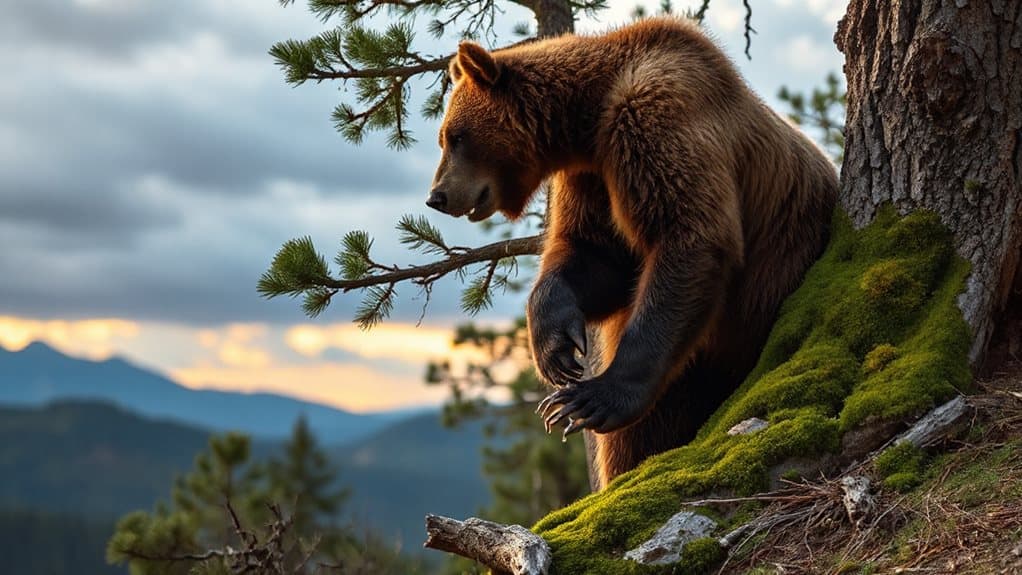
How exactly do brown and grizzly bears manage to climb, and what holds them back?
You’ll see them grip with straight, digging‑oriented claws, pull up using front legs while pushing with rear limbs, and favor thick, ladder‑like branches that can bear their 400‑800‑lb weight.
Their fixed wrists, inward‑turning paws, and massive muscle mass limit agility, making climbs slower and restricting them to sturdy, low‑height trees.
Hunting laws were originally enacted to conserve wildlife and ensure the availability of game for future generations.
Why Are Sun and Spectacled Bears the Hidden Arboreal Specialists of Bear Climbing?
If you look closely at tropical forests, you’ll see sun bears and spectacled bears effortlessly traversing the canopy, a skill most other bear species lack.
Their compact bodies, inward‑turned paws, and curved claws act like natural climbing hooks, while strong forearms and flattened chests generate pull and reduce drag.
Forward‑placed eyes give depth perception, and thick coats shield them, rain and bark, letting them hunt honey, fruit, and insects high above.
Fresh signs like five‑toed impressions in mud or on trunks can help confirm recent arboreal activity, especially when found alongside short claw marks.
How Bears Use Their Claws, Muscles, and the “Bear‑Hug” to Climb
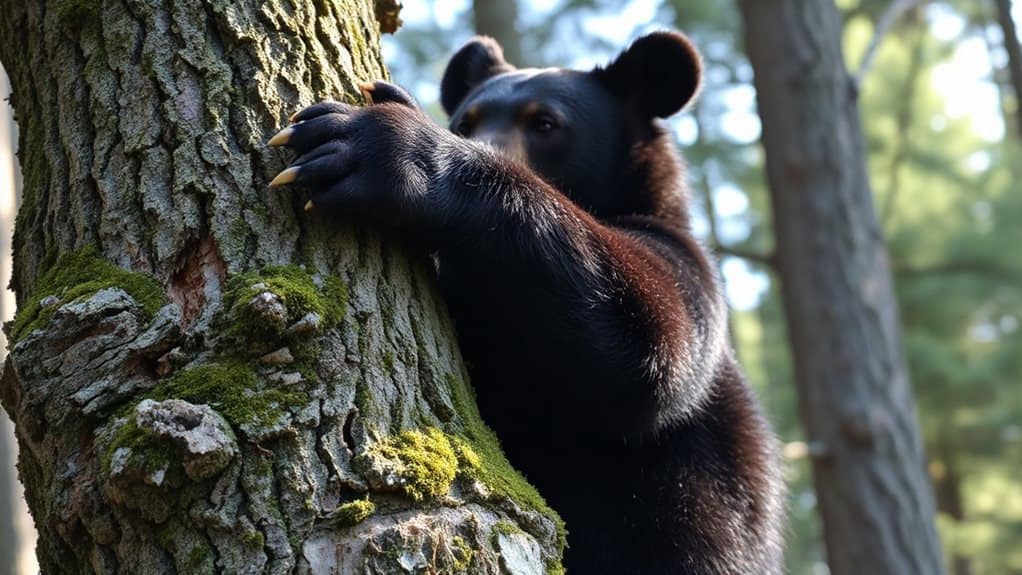
You’ll notice the bear’s claws act like tiny hooks, digging into bark to give a firm grip that lets the animal pull itself upward.
When the front paws lock in place, the powerful hind‑leg thrust drives the body higher, while the shoulder and back muscles add the necessary lift.
Clawed Grip Mechanics
When a black bear tackles a tree, its short, curved claws act like natural grasping hooks, catching bark and slipping into crevices with a sharp precision that longer, straighter claws simply can’t match.
You’ll feel the forelimbs pull, shoulders rotating wide, and the bear‑hug grip spreading pressure, creating a three‑point hold that maximizes friction, balances the body, and lets you ascend effortlessly.
Powerful Hind‑Leg Thrust
The claws that lock onto bark give the bear a solid foothold, but it’s the explosive push from the hind legs that actually launches the animal upward.
You’ll feel the sudden, powerful thrust as the rear muscles contract, propelling the body at up to 10 mph, almost like running up a trunk.
Smaller bears, with higher leg‑to‑weight ratios, generate the most rapid, efficient ascents, turning vertical travel into swift, liberating motion.
Bear‑Hug” Ascending Technique
If a bear wraps its forelimbs around a tree trunk, it creates a “bear‑hug” that turns the bark into a solid support platform while the animal pushes upward with its hind legs.
You’ll see its curved claws dig into fissures, shoulders compress the trunk, and core muscles coordinate twists, letting it cling to large, rough bark, maintain balance, and ascend efficiently, especially on bulky trunks where ordinary handholds fail.
Why Bears Climb: Food, Safety, and Play
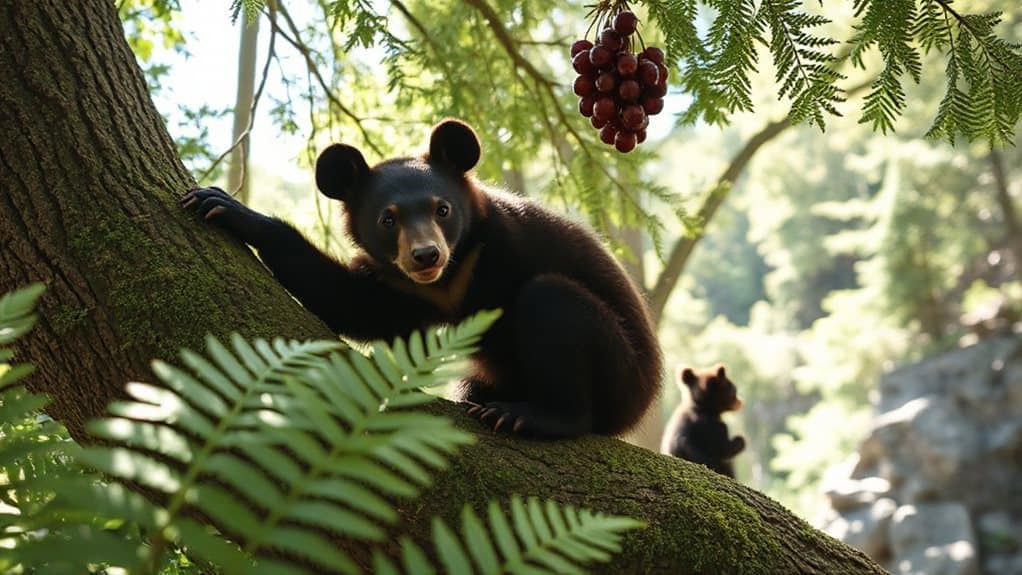
Because bears need food, safety, and play, they often turn to trees, and each of those motivations shapes their climbing behavior in distinct ways.
You’ll see them scaling trunks for berries, nuts, insects, or even human trash, expanding foraging options and building fat reserves.
When threatened, they retreat upward for escape or observation.
Cubs practice climbing as play, sharpening balance, strength, and future survival skills.
Many famous bears, like Winnie-the-Pooh, are remembered for their tree-related adventures that reflect real climbing behaviors.
Can Climbing a Tree Keep You Safe From a Bear? Myths Debunked
When a bear shows up, climbing a tree might seem like a quick fix, but it’s far from a reliable escape plan.
You’ll find black bears scramble up fast, brown bears can follow if branches are sturdy, and even large grizzlies sometimes reach higher trunks.
Trees rarely guarantee safety; they can give a false sense of security, especially when bears use thick limbs or push weaker trunks.
Choose avoidance over climbing.
How to Stay Safe When a Bear Is Climbing Near You?
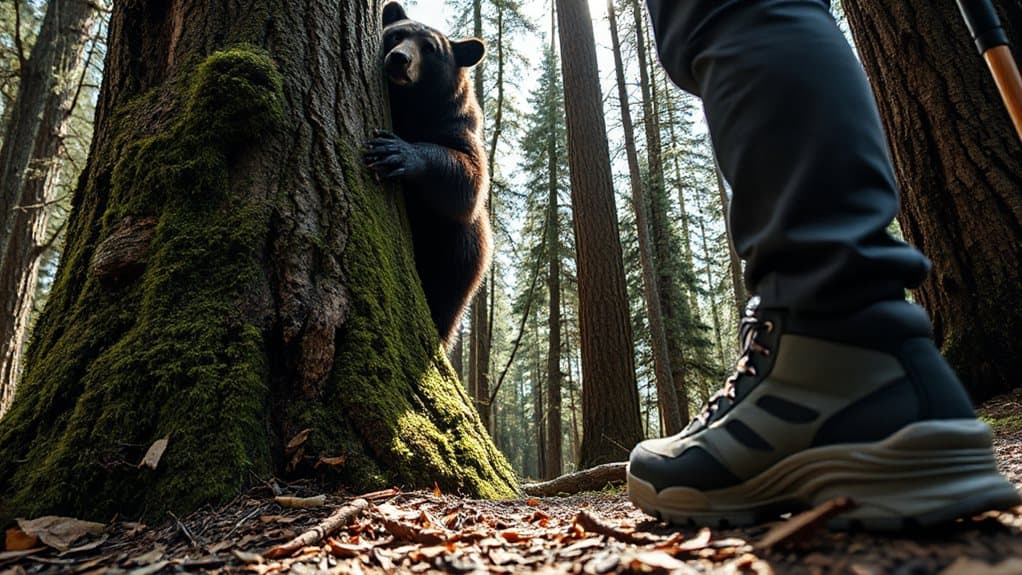
Even as a bear claws its way up a tree nearby, staying safe hinges on keeping calm and acting deliberately.
Face the bear, back away slowly, keep children and leashed dogs close, and avoid blocking its path.
Speak firmly, raise your arms, make noise, and keep bear spray ready.
Once it moves, leave the area, check for others, and report any aggression.
Quick Reference: Species, Speed, and When to Worry
If you’re out in bear country, knowing which species can sprint up a tree and how fast they do it helps you gauge the real risk.
Black bears zip upward 10‑15 ft/s, scaling 50 ft in five seconds, while grizzlies crawl, taking minutes for short climbs.
Polar bears can’t climb.
Cubs are quick, adults slower; thin trunks and low branches make any ascent easier, so watch species and speed to decide when to worry.
And Finally
You’ve learned that bears aren’t clumsy climbers; many species—especially black, sun, and spectacled bears—scale trunks quickly for food, safety, or play. Brown and grizzly bears can climb, but their size and weight limit them. Remember, a tree isn’t a reliable refuge; instead, stay calm, make yourself small, and back away slowly. Knowing each species’ climbing abilities helps you assess risk and react wisely when a bear is nearby.


