You’ll find that fish‑eating birds do swallow live fish whole, but they don’t keep them alive for long. The bird grabs the catch, turns it head‑first to reduce resistance, and slides it down a narrow esophagus where water can’t reach the gills, so oxygen stops almost immediately. Acid in the proventriculus softens flesh and scales, then the muscular gizzard crushes the weakened body into pulp. Most fish die within seconds to a few minutes, though larger ones may linger up to fifteen minutes before the digestive system finishes the job. Keep exploring for more details.
TLDR
- Most fish‑eating birds swallow live fish whole, but the fish die within seconds to minutes after entering the throat.
- Head‑first orientation reduces resistance and prevents spines from catching, allowing rapid passage through the upper tract.
- Once out of water, the fish cannot breathe; throat compression and loss of water flow cause immediate oxygen deprivation.
- Acidic stomach secretions and gizzard grinding begin after the fish is already dying, completing digestion.
- The brief swallowing process (a few seconds) is far shorter than the fish’s remaining oxygen reserves, so the bird cannot keep the fish alive.
Do Fish‑Eating Birds Swallow Live Fish?
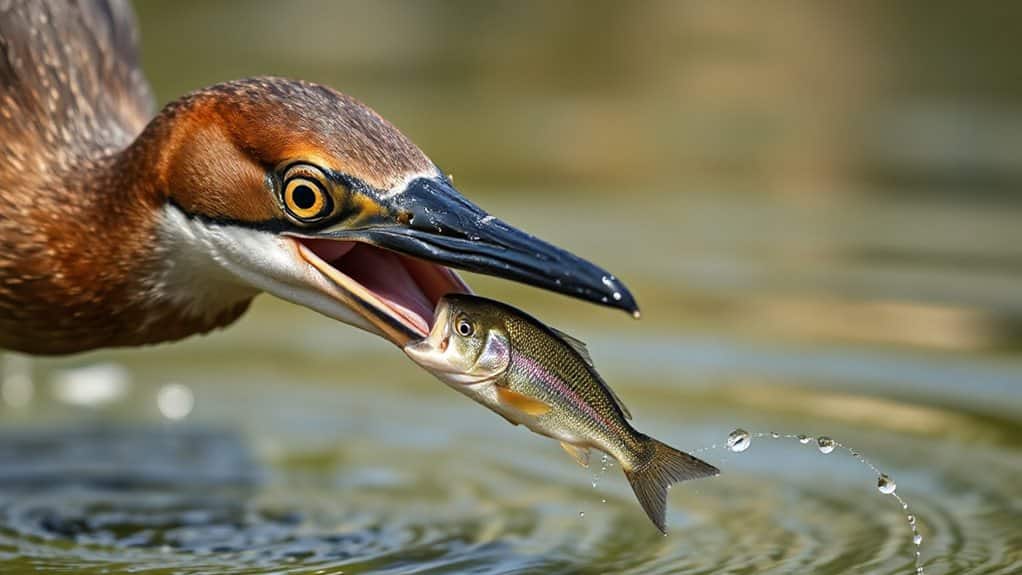
If you watch a heron or a kingfisher stalk a pond, you’ll see that many of these fish‑eating birds actually swallow live fish whole, especially when the prey is small enough to glide through their throats without injury.
You’ll notice they turn fish headfirst, preventing spines or fins from catching, and their strong, acidic stomachs quickly dissolve bones and scales, ensuring rapid, efficient feeding without waste. The bird’s gizzard then grinds the softened remains before they pass into the intestine.
How Long Does a Fish Stay Alive While Being Swallowed?
You’ll notice that the swallowing process itself lasts only a few seconds, yet the fish’s oxygen reserves can keep it alive for up to several minutes, sometimes stretching to fifteen‑plus minutes if the temperature is low.
As the bird’s throat compresses the gills, mechanical trauma and the rapid loss of oxygen combine to shut down respiration, while digestive enzymes only act after the fish is already dying.
Factors like fish size, water trapped in the mouth, and the predator’s stomach acidity all influence whether the fish wiggles for half a minute or barely moves at all.
Some large predators, especially those that target structure-loving muskies, may swallow prey in ways that affect how long the fish remains alive.
Swallowing Duration
Usually, a fish’s life ends within minutes after a bird swallows it, because the combined forces of mechanical crushing, oxygen loss, and rapid acid exposure act almost simultaneously.
You’ll notice that smaller fish die in seconds to minutes, while larger ones might linger up to fifteen minutes before the gizzard grinds and stomach acid finishes the job.
Temperature, size, and bird species all shape that narrow window.
Oxygen Depletion Timing
When a bird grabs a fish and begins the swallowing process, oxygen deprivation starts the instant the fish leaves the water and passes the throat, because its gills can no longer draw oxygen‑rich water across the delicate membranes.
You’ll have only seconds to a few minutes—often under ten—before the trapped oxygen runs out, faster in warm conditions, slower if cold or small.
Survival beyond fifteen minutes is rare.
Mechanical Digestion Impact
After the fish leaves the water, oxygen loss is just the first hurdle; the real clock starts ticking the moment the bird’s throat clamps down.
You feel the throat’s tight grip, head‑first passage, and rapid esophageal contractions that bruise and compress the fish.
Within seconds to a few minutes, the gizzard’s grinding and acidic secretions finish the job, ending any chance of survival.
Why Do Fish‑Eating Birds Turn Fish Head‑First?
Because a fish’s shape is naturally tapered toward its head, turning it head‑first lets the bird’s throat and esophagus handle the prey with far less resistance.
You’ll feel the fish’s scales lie flatter, reducing friction, while fins and spines stay tucked away, preventing scrapes or punctures.
Flexible necks, long bills, and kinetic jaws let you rotate the catch, ensuring smooth passage through the narrow upper tract and enhancing feeding efficiency.
What Kills a Fish Inside a Bird’s Esophagus?
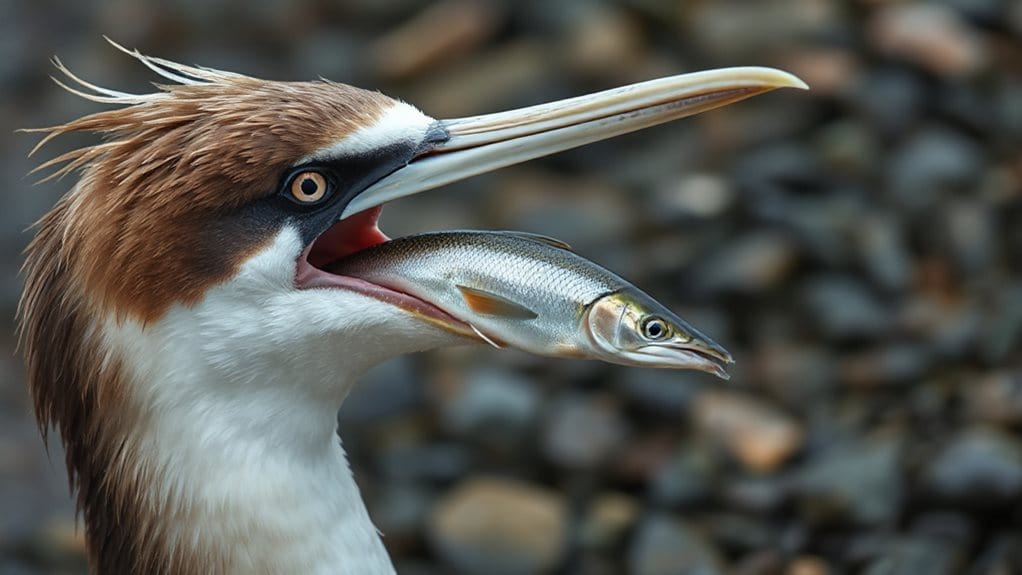
You’ll notice that as soon as the fish slides into the bird’s esophagus it’s cut off from oxygen, so suffocation kicks in within seconds; the cramped, water‑free passage offers no chance for the fish to breathe.
At the same time, the muscular walls of the esophagus and the grit‑filled gizzard grind and squeeze the fish, causing physical trauma that quickly destroys its tissues.
Together, oxygen deprivation and relentless mechanical breakdown ensure the fish dies long before it ever reaches the stomach.
Many birds also rely on stored fat/oil and high-energy meals like instant rice and noodles to fuel the intense muscular effort required during feeding and digestion.
Oxygen Deprivation in Esophagus
When a fish slides down a bird’s throat, the esophagus instantly becomes a low‑oxygen chamber, cutting off the water flow the fish needs for gill ventilation.
You’ll see oxygen drop within minutes, causing ATP loss, cellular failure, and rising CO₂.
Blood pH collapses, hemoglobin falters, and tissues starve.
Smaller, warm‑water fish die fastest; even tolerant species eventually suffocate.
Mechanical Trauma and Gizzard Grinding
If a fish manages to slip past the esophagus and reaches the gizzard, the bird’s powerful muscular grinding quickly turns the struggle into a lethal crush.
You’ll feel peristaltic waves compressing the fish, then bone‑shattering contractions that pulverize scales and skeleton, while acidic juices dissolve tissue.
The combined trauma, grinding, and enzymatic breakdown guarantees the fish can’t survive.
How Do the Proventriculus, Gizzard, and Crop Destroy the Fish?
Although a fish may slip past the crop relatively intact, the real breakdown begins once it reaches the proventriculus and gizzard. The crop merely stores and moistens the fish, keeping it whole briefly.
Then the proventriculus pours acidic HCl and pepsin, softening flesh and eroding scales.
Finally, the gizzard’s muscular walls and grit crush, tear, and grind the weakened body into pulp. Freshwater shrimp also consume decaying plant materials and contribute to breaking down organic matter in aquatic environments.
How Much Time Can a Swallowed Fish Survive, and Why?
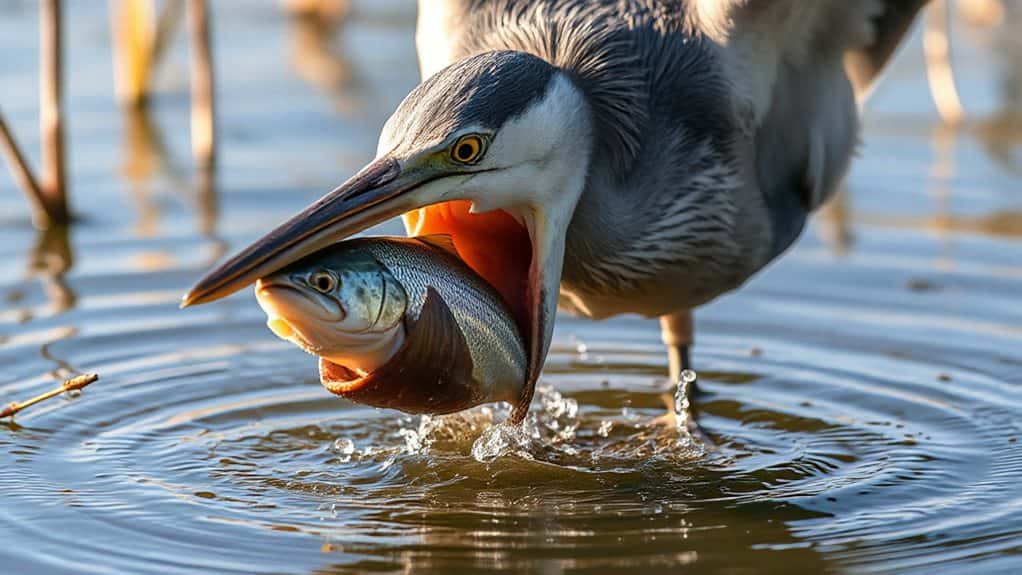
Within roughly 15 to 25 minutes after a fish slips past the crop and into the predator’s throat, it usually runs out of oxygen and dies.
You’ll see that low water temperature can stretch that window a bit, while size, temperature, and throat anatomy shorten it.
Suffocation dominates, not acid, because gills lose oxygen quickly, and scales only delay damage.
Your fish may twitch briefly, but brain injury starts early.
Modern bait formulations often include protein-rich nutrients that mimic hatchery foods and can attract predators.
What Evidence Shows Swallowed Fish Die Within Seconds?
Swallowing a fish cuts off its oxygen supply instantly, and the bird’s esophagus offers no way for gas exchange, so the fish begins to suffocate the moment the throat closes.
You’ll see that observations of cormorants gulping fish in under fifteen seconds, plus studies noting asphyxiation within seconds to minutes, confirm rapid death.
Acidic stomach fluids and crushing gizzard grit further destroy gills, leaving no chance for survival.
And Finally
You’ve learned that fish‑eating birds don’t actually keep their prey alive while swallowing; the fish dies within seconds as it slides head‑first into the esophagus, where the proventriculus and gizzard crush and grind it. The rapid descent, combined with the bird’s powerful digestive muscles, leaves no chance for the fish to survive. So, despite the dramatic image of a live fish being gulped, the reality is that the bird’s anatomy guarantees the fish’s swift demise.