
High‑power canister stoves burn about 6‑8 g of fuel per minute on the high setting, producing roughly 3 kW of heat, which boils 1.8‑2.1 L of water per 28 g canister; a 100‑gram canister therefore powers 6‑8 meals or 2 hours of vigorous boiling. Simmer mode and heat‑exchanger setups can cut consumption by 15‑30 % for stews or sauces, while colder or higher‑altitude conditions may raise use by 20‑50 %. Adding a 30‑40 % safety margin covers wind, cold and extra cooking, and a quick reference shows a 100‑gram canister lasts about 6‑8 meals, 2 hours boiling, or 4 hours simmering—keep reading for deeper details.
TLDR
- Typical high‑output canister stoves burn 6–8 g fuel per minute on high, delivering ~3 kW heat.
- Average fuel‑per‑boil is about 7–8 g per liter of water; a 110 g canister yields ~13–15 L boiled.
- Daily fuel needs: 25–30 g per person at sea‑level summer; add 15–20 % per 1,000 ft altitude and 30–50 % in cold (<50 °F).
- Simmer mode, heat‑exchangers, and partial‑fill bottles can cut consumption 10–30 % versus full‑flame boiling.
- Plan a 30–40 % safety margin for wind, altitude, and cold; a 100 g canister generally supports 6–8 meals or 2 hours high‑heat cooking.
Calculate High‑Power Canister Stove Fuel Consumption
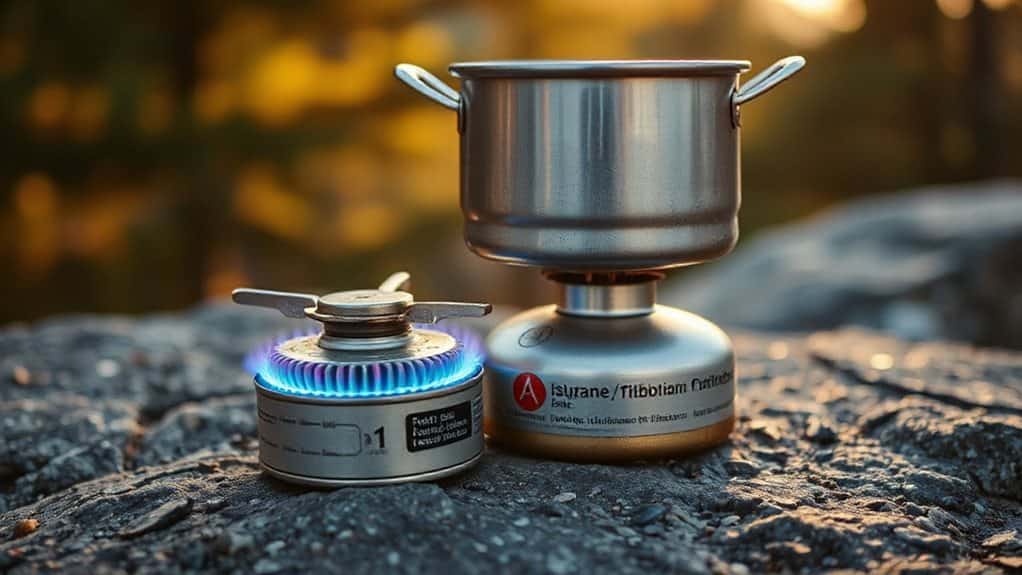
When you’re planning a high‑power canister stove, start by figuring out the burn rate: most high‑output models consume roughly 6–8 g of fuel per minute on the high setting, according to SOTO, and they typically deliver up to 3 kW of heat. Use MSR’s boil‑volume ratios—about 1.8–2.1 L per 28 g—to estimate grams per boil, then multiply by daily boils, adding a margin for wind, altitude, and inefficiency. Matching pot size to the flame pattern can further improve fuel efficiency. Ensure you also provide proper ventilation whenever operating stoves to avoid buildup of combustion byproducts.
Reduce Canister Stove Fuel Use With Simmer‑Mode & Heat‑Exchanger Setups
If you lower the flame and add a heat‑exchanger pot, you’ll cut canister fuel use without sacrificing cooking performance.
Simmer mode reduces peak demand, letting you keep a gentle heat for stews, rice, or sauces, while a partly filled bottle lowers pressure for finer flame control.
Pairing this with a heat‑exchanger captures exhaust heat, shortens boil times, and minimizes wind‑driven loss, keeping your stove efficient and your freedom intact.
Choosing an isobutane‑propane blend can help maintain pressure and performance in cold or high‑altitude conditions for longer, improving overall fuel efficiency when used with these techniques and heat‑exchanger setups.
Compare Canister Stove Fuel‑Per‑Boil Benchmarks (Real‑World Numbers)
You’ll notice that fuel‑per‑boil numbers can swing a few grams between models, so a Jetboil MiniMo at 7.8 g/L and an MSR PocketRocket 2 around 8 g/L already show a measurable efficiency gap.
Real‑world tests also reveal that regulated stoves tend to keep consumption steadier as the canister empties, whereas unregulated units let the boil time climb and the fuel use drift upward.
Boil Efficiency Variance
Even though all three stoves—BRS3000, Pocket Rocket 2, and WindMaster—used the same 110 g canister, their fuel‑per‑boil numbers diverge noticeably, showing that stove design matters as much as canister size.
You’ll see the WindMaster keeping the shortest boils, the Pocket Rocket 2 close behind, while the BRS3000, though slower, leaves the most fuel after the same volume, illustrating how regulated valves and pressure handling drive efficiency variance.
Fuel Consumption Per Boil
How much fuel does each boil actually cost you? A typical canister stove uses about 13–15 g per liter, so a 0.5 L cup costs roughly 7–8 g.
Integrated systems drop that to 10–12 g per liter, while white‑gas stoves need 17–22 g.
Real‑world Jetboil users report 5 g for 500 mL, and conventional stoves hover around 7–8 g per boil.
This translates to 6–8 boils per 100 g canister, balancing weight and autonomy.
Estimate Daily Canister Stove Fuel Needs by Season & Altitude
When you’re planning a trip, the amount of fuel you’ll need each day depends mainly on the season and the altitude of your campsite.
In summer at sea level you’ll use roughly 25‑30 g per person, but add 15‑20 % for every 1,000 ft gain; at 8,000 ft or higher, expect 40 g daily.
Cold weather below 50°F pushes you to 30‑50 % more, and snow‑melting can double the baseline.
Adjust your canister size accordingly.
A quick test boil before your trip can help you track actual usage and estimate needs more accurately, especially for different canister sizes.
Add a Safety Margin to Canister Stove Fuel for Wind, Cold, and Extra Cooking
You’ll want to add a wind‑adjusted fuel factor, because even a light breeze can double your consumption, and a cold‑temperature increase can shave another 20‑50 % off your canister’s efficiency.
On top of that, allocate an extra‑cooking buffer for simmering, snow‑melting, or prolonged boiling, which typically adds 30‑40 % more fuel.
Wind‑Adjusted Fuel Factor
Even a light breeze can turn a normally efficient canister stove into a fuel‑guzzler, so adding a wind‑adjusted safety margin is essential for reliable cooking in the backcountry.
Account for a 12‑15% buffer, use a windscreen that cuts consumption by at least 12%, and keep the valve low.
Adjust for worst‑case wind, then plan canister capacity with that margin to stay fueled and free.
Cold‑Temperature Consumption Boost
Add a safety margin to your fuel plan whenever you expect cold temperatures, because low‑temperature canisters vaporize fuel less efficiently and deliver weaker flames, which lengthens boil times and increases total consumption.
In practice, pack 20‑30 % extra fuel, keep the canister warm in your pack or a hot water bath, and avoid letting it run empty, since pressure drops worsen performance and can cause cut‑outs.
Extra‑Cooking Buffer Allocation
Cold temperatures already force you to carry extra fuel, but wind and extra cooking tasks can push consumption even higher, so you need a dedicated buffer that covers those variables. Double your canister amount when you expect a 5 mph breeze, and add another 20‑30 % for simmering, pasta, or snow‑melt meals.
Pack natural windbreaks, avoid fully enclosing the stove, and keep a day‑long reserve for unexpected boils or reheating, ensuring freedom to cook without worrying about fuel shortages.
Quick Canister Stove Fuel Reference: Stove, Meal, Trip Length
A 100‑gram canister typically powers 6‑8 meals, so for a short backpacking trip you’ll usually need just one canister to cover two to three days of cooking.
You’ll get roughly 2 hours of high‑heat boil time or 4 hours simmer, meaning a single canister handles 6‑8 meals comfortably.
For 5‑7‑day trips, plan 2‑3 canisters; beyond that, liquid fuel becomes weight‑efficient.
And Finally
Remember, a high‑power canister stove typically burns 0.2 L of fuel per 10‑minute boil, but simmer‑mode and a heat‑exchanger can slash that by up to 30 %. Real‑world tests show 1 L lasting 4–5 boils at sea level, less at altitude or in cold wind. Plan for a safety margin—add 20 % extra for gusts, low temps, and unexpected meals. By estimating daily use based on season, altitude, and meal count, you’ll pack the right amount and avoid running out when you need it most.


