
You’ll usually get 1–3 miles with walkie talkies, even though brands claim up to 50. Those high numbers? They’re from perfect, open-desert tests—think mountain to mountain, no trees or buildings. In cities or forests, expect less due to obstacles blocking signals. FRS models often max out under 2 miles, while GMRS can reach farther with a license. For real long-range, consider POC radios. There’s more to know about enhancing your signal where it counts.
TLDR
- Walkie talkie range varies from 1–3 miles in open areas, but urban environments reduce it to around 1 mile due to obstructions.
- Manufacturer claims of 30+ miles assume ideal line-of-sight conditions rarely achievable in real-world use.
- FRS radios typically reach under 2 miles due to low power, while GMRS models can reach up to 20 miles in optimal conditions.
- Terrain, buildings, trees, and antenna height significantly impact signal strength and effective range.
- Using repeaters or cellular-based POC radios can extend coverage far beyond traditional walkie talkie limits.
How Far Can Walkie Talkies Really Reach?
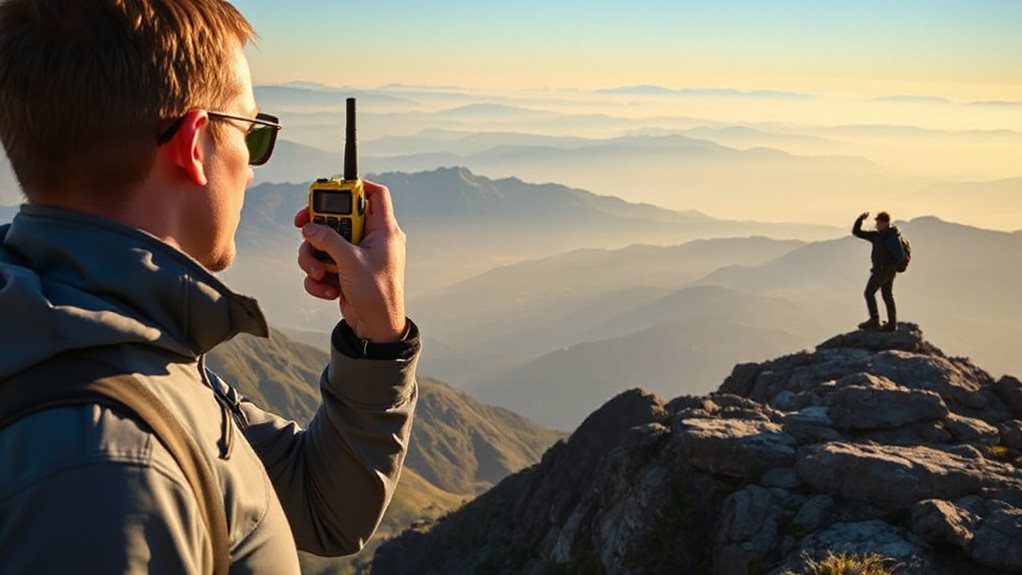
How far can your walkie talkie actually reach? In open areas, you’ll typically get 1–3 miles, with some models hitting 9 miles.
City use drops range to about 1 mile due to buildings.
FRS radios claim up to 35 miles ideal, but real-world conditions cut that sharply.
Your actual range depends on power, terrain, and frequency—know your environment for best results. Some models, like the T10 X-Talker®, can achieve up to 20 miles under optimal conditions such as open water or mountain-top to mountain-top with no obstructions.
Park water is safe to drink, but it has a high mineral content that may make bottled water preferable.
Why Are Manufacturer Range Claims Misleading?
You’ve probably seen walkie talkies claiming 50-mile ranges, but those numbers only happen in perfect, real-world-rare conditions like open water or flat deserts with antennas high in the air.
In truth, your actual range will be way shorter because obstacles like buildings and trees block signals, and the low power of consumer radios limits performance no matter what the box says.
Those bold claims rely on ideal line-of-sight tests that don’t reflect how you’ll really use them, making it easy to overestimate what your radio can do.
Remember that real-world regulations and device limitations vary by region and device type, so always check local licensing requirements before relying on a radio for important communications.
Line Of Sight Reality
While you might see walkie-talkies advertised with ranges up to 30 or even 50 miles, those numbers are based on near-perfect conditions that most users will never experience. You need true line-of-sight—unobstructed paths, high elevation, and no interference.
In reality, terrain, buildings, and weather block signals. So, your actual range? Usually just 1–3 miles, even with a clear path.
Power Versus Performance
Even with a powerful signal and top-tier gear, you’re unlikely to hit the bold range numbers advertised on the box—because real-world performance depends on far more than wattage alone.
You’ll see claims of 30+ miles, but terrain, interference, and regulations limit most FRS radios to under 2 miles.
Higher power helps, yet without clear line of sight, even 5 watts won’t deliver extreme distances.
Ideal Conditions Myth
Those big range numbers plastered across walkie-talkie packaging—30 miles, even 50—aren’t lies, but they’re not reality either.
They’re achieved only in ideal conditions: high elevation, open terrain, zero interference.
Out in the real world, with buildings, trees, and weather in play, you’ll get maybe half a mile.
Don’t be fooled—those claims are technically true but practically meaningless for everyday use.
Which Walkie Talkie Service Has the Longest Range?
You’ll get the most range by using services with maximum power and licensed bands, like GMRS, which can reach up to 20 miles in open areas.
Unlike unlicensed FRS radios limited to 2 watts, licensed options let you tap into stronger signals and better antennas.
For truly long distances, though, cellular-based systems like Poclink or the Walt Smart Radio System beat traditional radios by connecting through LTE and Wi-Fi networks.
Always inspect and maintain your equipment after heavy use to ensure safety and performance, including checks for internal damage that may not be immediately visible.
Maximum Power Services
When you’re pushing the limits of communication, power matters—especially if you want your signal to travel far and clear.
GMRS leads with up to 50 watts, far surpassing FRS’s 2-watt cap. Handhelds max at 5 watts, reaching 1–5 km, while repeaters extend range to 25 km.
More power means better performance over hills and obstacles, giving you the freedom to roam farther without losing contact—ideal for rural or rugged terrain where every mile counts.
Licensed Vs Unlicensed Bands
You’ve seen how maximum power can stretch your signal across rugged terrains, but the real key to long-range communication lies in the rules behind the radio—specifically, whether you’re using a licensed or unlicensed service.
Licensed bands give you exclusive frequencies, higher power (up to 50+ watts), and less interference, so your signal travels farther, clearer. Unlicensed options like PMR446 or FRS are convenient, but shared channels and low power (often 0.5 watts) limit range and reliability—ideal for short, casual use.
If you want freedom to roam with solid, long-distance reach, licensed is the way to go.
How Do Terrain and Obstacles Reduce Range?
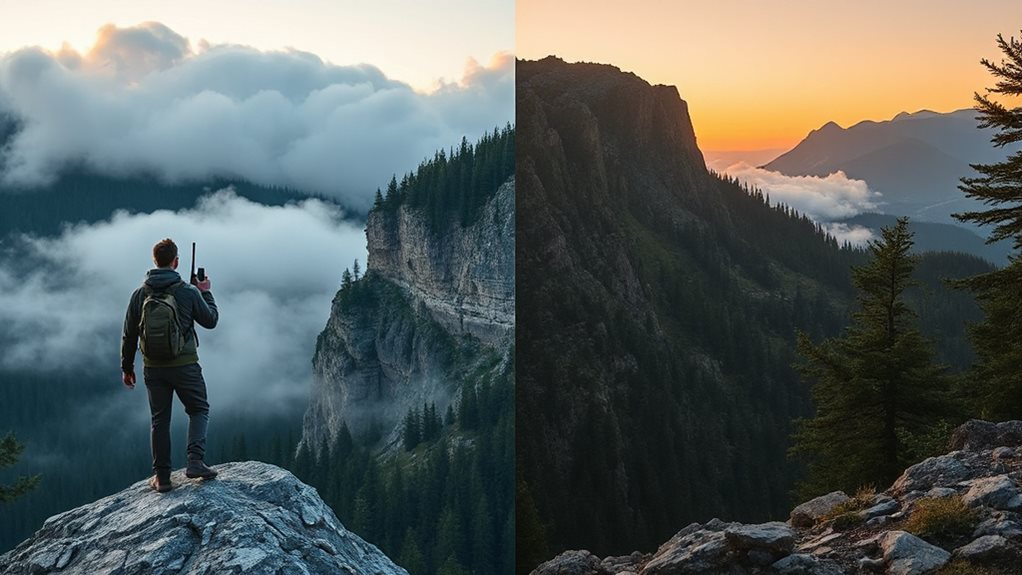
While open fields and flat scenery give you the best chance to maximize your walkie-talkie’s range, real-world terrain and obstacles often stand in the way of clear communication.
Hills, mountains, and dense forests block or weaken signals—especially VHF.
Urban buildings, trees, and even crowds absorb or reflect radio waves, cutting range fast.
Stay aware, adapt your position, and use higher ground when you can.
Grounding a generator with a proper copper grounding rod and wire improves safety by providing a direct path for electrical faults.
How Can You Boost Walkie Talkie Range?
Want to get the most out of your walkie talkies? Upgrade your antenna for better signal reach, and mount it high, like on a vehicle roof, to avoid interference.
Use repeaters to extend coverage across obstacles.
Choose UHF for indoor use, crank up the wattage, and position yourself up high.
Hold your radio vertically, and apply signal techniques like companding to cut noise—simple tweaks that seriously enhance range.
Check the generator control if you experience unexpected shutdowns, as issues like a Service Shutdown can indicate a problem that interrupts power.
Should You Use POC Radios Instead for Long Distance?
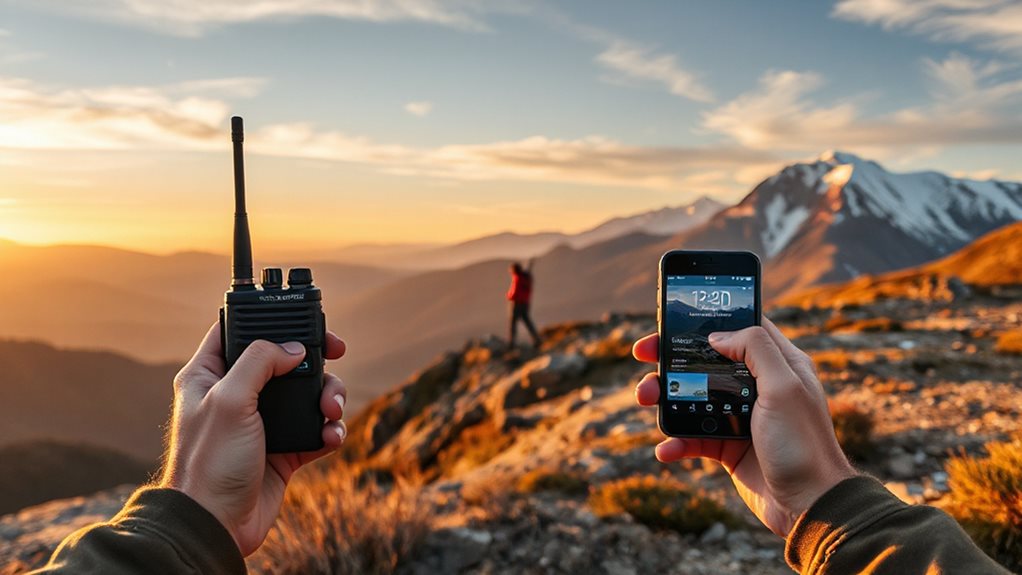
When it comes to covering long distances, traditional walkie-talkies might fall short—no matter how high you mount the antenna or how powerful the wattage.
Instead, consider POC radios: they work anywhere with cell coverage, cost less annually, need no license, and let you text, track GPS, and even communicate across continents—perfect for teams on the move who value simplicity, freedom, and reliable long-range contact without bulky infrastructure.
Final Note
You now know walkie talkie range depends on more than just specs. Real-world conditions like buildings, trees, and hills cut through claimed distances fast. While some models promise miles, you’ll likely get much less in cities or forests. For longer reach, consider POC radios using cell networks. They’re reliable over vast areas. Choose the right tool for your environment, and you’ll stay connected when it matters most.


