
You see lakes freeze top‑down because water is densest at 4 °C; as the surface cools below that, the colder, lighter water stays on top while the 4 °C water sinks, forming a stable bottom layer. The denser water pools beneath a thin ice sheet that floats thanks to ice’s lower density, and the ice acts as an insulating lid that traps heat. This combination keeps the deep water liquid even when the air is below freezing, and the pressure at depth further lowers the freezing point, allowing a liquid layer to persist. Continue exploring and you’ll uncover the seasonal dynamics and ecological impacts.
TLDR
- Water is densest at 4 °C; colder surface water becomes less dense and stays above the 4 °C layer.
- As the surface cools below 4 °C, the denser 4 °C water sinks, forming a bottom layer that resists further cooling.
- Ice, being less dense (≈0.917 g/cm³), floats and creates an insulating lid that traps heat beneath it.
- The lid limits heat loss, allowing the water just below the ice to remain near 4 °C while the surface freezes.
- Pressure at depth slightly lowers the freezing point, so deeper water stays liquid even when the surface is frozen.
Water Density Anomaly: Why It Is Heaviest at 4 °C
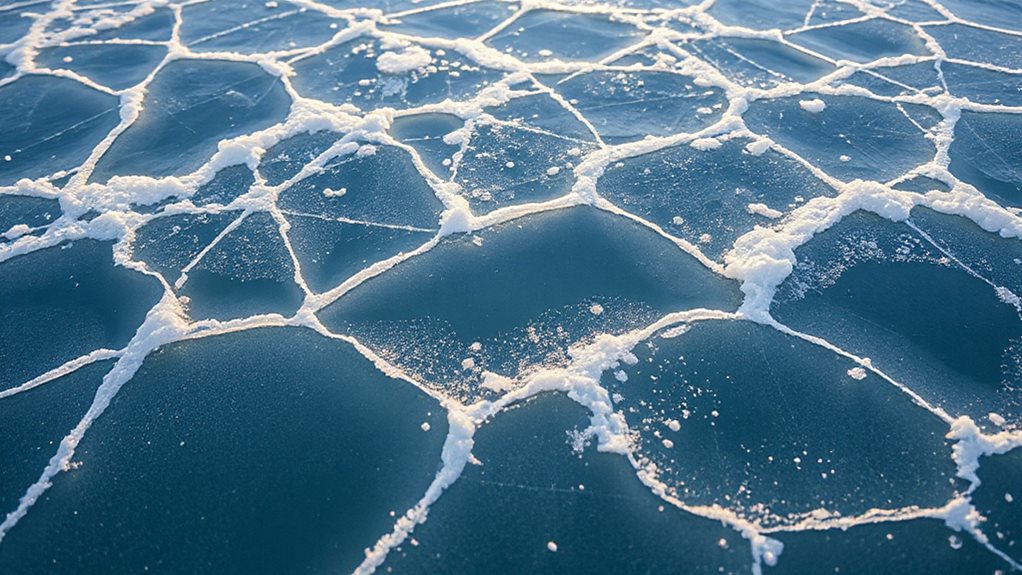
Why does water hit its maximum density at 4 °C? At that temperature, molecules vibrate just enough to lock into stable hexagonal hydrogen‑bonded clusters, creating a tightly packed arrangement. Above 4 °C, kinetic energy breaks those bonds, spreading molecules apart and lowering density. Below 4 °C, larger ice‑like aggregates form, expanding the structure and reducing density again. This balance gives water its heaviest point at four degrees. The bent molecular geometry of H₂O leads to a polar distribution of charge, which is essential for hydrogen‑bond network formation. Understanding this anomaly also explains why surface ice insulates aquatic life and preserves lake ecosystems.
How Surface Cooling Sends 4 °C Water Downward
Since water reaches its greatest density at 4 °C, the moment the lake’s surface cools below that point, the denser 4 °C water formed just beneath the skin begins to sink. You’ll see it plunge through convection currents, aided by wind‑driven mixing, until the whole column stabilizes at 4 °C.
Further cooling makes the surface lighter, so the 4 °C layer stays at depth, setting the stage for ice formation above. The phenomenon is often featured in outdoor programming like Waterfowl Obsession, which captures natural processes alongside hunting footage.
How Ice’s Low Density Creates a Floating Insulator
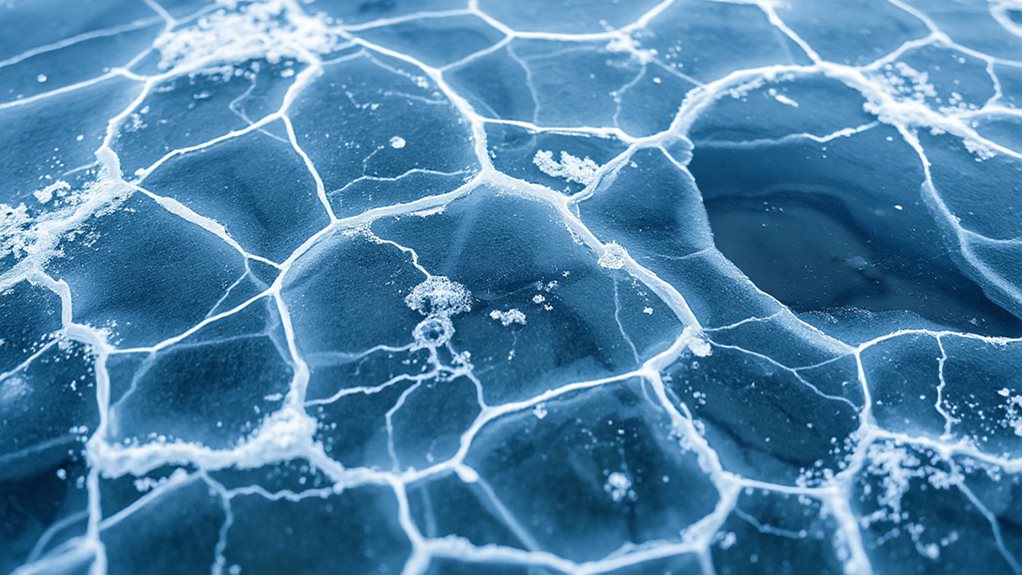
What makes a lake’s surface turn into a protective lid is the fact that ice is lighter than the water beneath it. Its hexagonal lattice expands, lowering density to about 0.917 g/cm³, so the frozen sheet floats. This floating lid traps heat, limits thermal loss, and keeps deeper water near 4 °C, preserving life and preventing total freezing. Trails and outdoor users should also respect natural systems by yielding to stock and staying on durable surfaces to prevent erosion and protect habitats like lakeshores, following principles such as yield to horses and staying on designated tread.
How Water’s Expansion Prevents Lakes From Freezing Solid
You’ll notice that water reaches its highest density at 4 °C, so as the lake cools the colder, lighter water stays near the surface while the denser layer below remains liquid.
When the surface finally hits freezing, the ice expands by about 9 % and floats, creating an insulating lid that slows heat loss and protects the deeper water.
This expansion, combined with the 4 °C density maximum, prevents the whole lake from solidifying, preserving an underwater habitat throughout winter.
Many hikers enjoy exploring coastal viewpoints like scenic viewpoints along rugged trails for similar seasonal contrasts.
Density Maximum at 4°C
Why does water behave so oddly at 4 °C, and what does that mean for a lake’s winter?
At 4 °C water reaches its highest density, so it sinks and pools at the bottom.
Above or below that temperature it expands, staying lighter and floating.
This creates a stable, cooler layer beneath warmer surface water, keeping the lake from freezing solid and preserving life.
Ice Insulates Underwater Habitat
When water reaches its maximum density at 4 °C, the colder, lighter water stays on top while the denser layer settles at the bottom, creating a stable thermal gradient. Ice then forms a thin, low‑conductivity lid that traps heat, slowing loss to the air.
That insulation keeps deep water liquid, supplies oxygen, and lets fish survive winter, preserving the lake’s hidden ecosystem.
Expansion Prevents Complete Freeze
How does water’s expansion keep a lake from turning into a solid block of ice? As temperatures dip below 4 °C, water expands, becomes less dense, and stays on top while warmer, denser water remains below.
Ice forms with lower density, floats, and insulates the depths. This buoyant layer blocks heat loss, so the lake freezes only at the surface, preserving liquid water underneath.
Seasonal Shift: Summer 4 °C Bottom to Winter Ice Cover
Ever notice how a lake’s bottom stays stubbornly cool even as summer heat bounces off its surface? In summer, that layer hovers around 4 °C, the densest water, forming a stable slab while warmer, lighter water floats above.
When autumn arrives, surface cooling drives mixing, but the 4 °C bottom persists, setting the stage for winter’s top‑down ice formation. Carrying the right winter gear and knowing body temperature management can help you stay safe if you’re out near frozen lakes.
How Pressure Lowers Freezing Point and Enables Supercooling in Deep Lakes
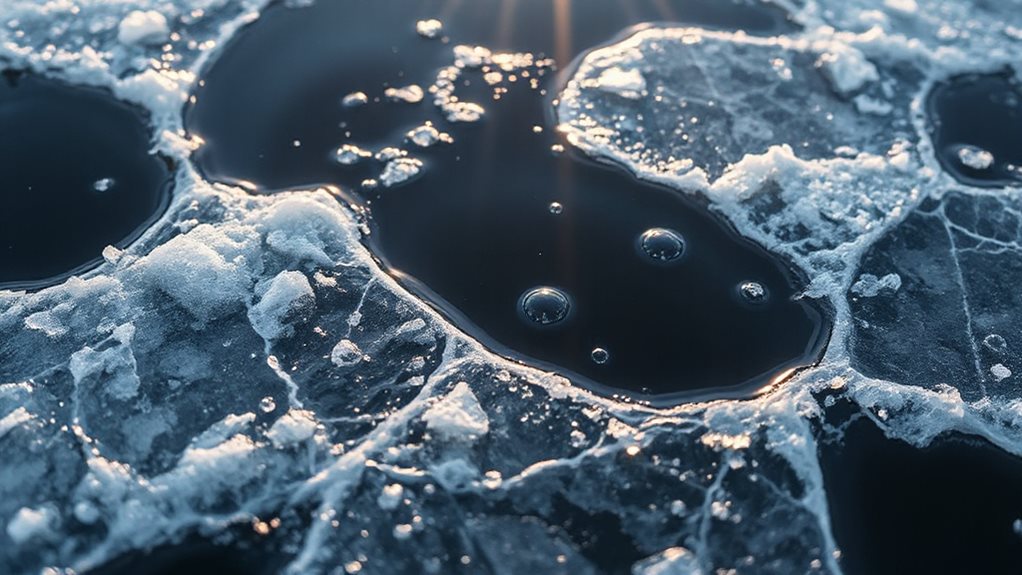
You’ll notice that as water gets deeper, the pressure rises and the freezing point drops a few degrees, so the bottom stays liquid even when the surface is at 0 °C.
This pressure‑induced supercooling lets the lower layers stay unfrozen, while the ice sheet on top acts as an insulating blanket.
Consequently, the lake freezes from the top down, never from the bottom up.
Pressure‑Dependent Freezing Point
Ever wondered why the deepest parts of a lake stay liquid while the surface freezes? Pressure from the water column lowers the freezing point—each extra atmosphere drops it about 0.0075 °C—so at 10 m depth the temperature can be 0.07 °C lower than at the surface.
This depression lets deep water stay supercooled, preventing ice nucleation until surface ice presses down.
Depth‑Induced Supercooling
Pressure from the water column lowers the freezing point, so as you go deeper the water can stay liquid even when the surface is at or below 0 °C.
At depth, pressure depresses the melting point, letting water supercool while surface layers freeze.
Geothermal heat, viscous dissipation, and latent heat from ice formation modestly warm the bottom, yet reduced heat flux still permits supercooling, allowing deep lakes to remain unfrozen beneath a solid crust.
Insulation From Ice Layer
A thin sheet of ice that forms on the surface does more than just look pretty; it acts as a powerful insulator, dramatically cutting the heat exchange between the lake’s interior and the cold air above. This ice barrier limits heat loss, while hydrostatic pressure at depth suppresses freezing, letting water stay liquid below 0 °C. As a result, deep layers stay near 4 °C, preserving life and freedom throughout winter.
Ecological Benefits of the Liquid Layer Beneath Ice
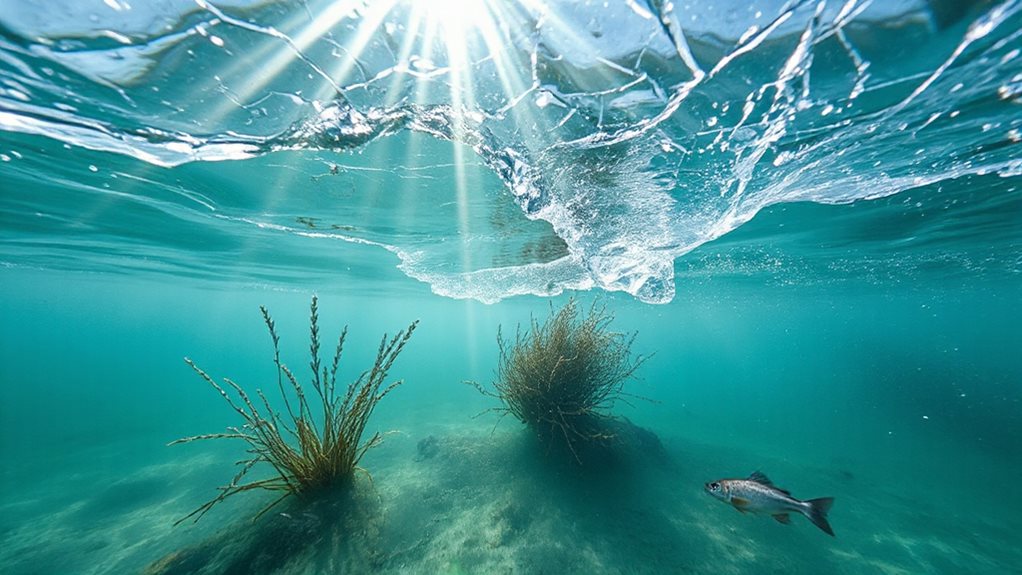
Why does the liquid layer beneath ice matter so much to a lake’s ecosystem? It keeps oxygen flowing, letting fish and microbes survive winter, while convection mixes oxygen‑rich water with nutrient‑laden depths, preventing stagnation.
Clear ice lets light fuel photosynthesis, boosting algae and carbon cycling.
This dynamic refuge also drives nitrification, mineralization, and gas exchange, sustaining biodiversity and preparing the lake for spring growth.
Common Misconceptions About Water’s Freezing Compared to Other Liquids
The liquid layer beneath ice isn’t just a winter refuge; it also highlights how water’s freezing behavior differs from most other liquids. You’ll find that pure water can supercool to –42 °C before homogeneous nucleation, while impurities trigger freezing at 0 °C.
Salt, sugar, or juice lower freezing points, and most other liquids become denser when solid, unlike water’s anomalous ice.
Final Note
You’ve learned why lakes freeze from the top down: water’s density peaks at 4 °C, so cooling surface water sinks, while ice’s lower density lets it float as an insulating lid. This lid keeps the deeper water just above freezing, preventing the whole lake from solidifying. Pressure further lowers the freezing point, allowing supercooling in deep waters. The resulting liquid layer protects aquatic life and maintains ecosystems throughout winter.


