
You start by picking a sharpener like a whetstone or portable tool, then set a consistent 15–20° angle to match your knife’s edge. Prep your stone by soaking it, stabilize it on a non-slip surface, and begin with a coarse grit to form a burr. Move through finer stones, removing the burr with light strokes, and finish with a strop for a polished, sharp edge—you’ll soon see how easy precision can be.
TLDR
- Choose a sharpening tool like whetstones or portable options such as the Work Sharp Pocket Knife Sharpener for on-the-go maintenance.
- Maintain a consistent 15–20° angle per side, matching the original bevel and adjusting for steel type and intended use.
- Prepare whetstones by soaking them until bubbles stop, then stabilize on a non-slip surface for safe, effective sharpening.
- Progress through coarse to fine grits, forming and refining a burr with even strokes, then remove it with light trailing passes.
- Finish by stropping on leather with compound, test sharpness safely, and clean the blade regularly for optimal performance.
Gather Your Pocket Knife Sharpening Tools
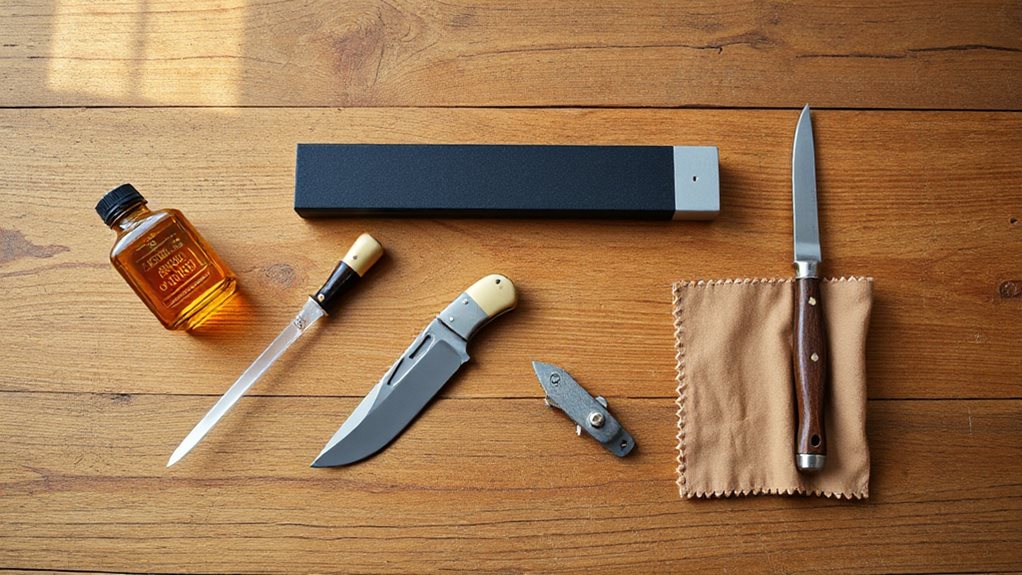
Grab your pocket knife and let’s get set up for a sharp edge—choosing the right tools makes all the difference.
You’ve got options: whetstones for control, diamond stones for speed, ceramic rods for fine-tuning. Guided sharpeners keep angles consistent, great for beginners.
Need portability? Try the Work Sharp Pocket Knife Sharpener or DMT Mini-Sharp—lightweight, reliable, and ready when you are. Many field-friendly tools prioritize high portability for on-the-go maintenance.
Set the Correct Sharpening Angle (15–20°)
While your pocket knife’s performance depends on more than just a sharp edge, getting the angle right is one of the most critical steps—you’ll want to aim for 15 to 20 degrees per side for most everyday tasks.
Match your knife’s original bevel first, typically around 20°, then adjust based on use.
Softer steels and heavy tasks favor 20°, while harder steels can go lower, like 15–17°, for finer cutting.
Use a guide or marker to stay consistent.
Lower angles offer sharper edges but chip easier, especially under impact.
For general EDC use, 17–20° strikes the best balance between sharpness and durability.
Regular maintenance, including wiping the blade after use and protecting it from corrosion, will help preserve the edge and overall performance; consider daily cleaning as part of your routine.
Prep Your Whetstone for Sharpening
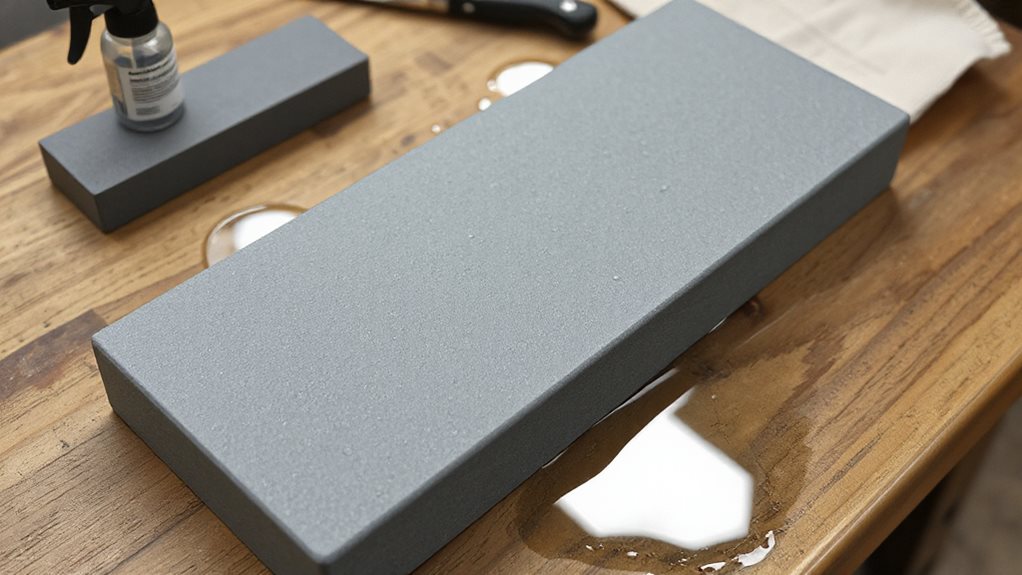
Grab your whetstone and soak it in water for 10–15 minutes—this keeps it from drying out and helps form the slurry you’ll need.
Set it on a steady surface, like your countertop, and use a damp cloth or non-slip base so it won’t slide around.
Once it’s stable and saturated, you’re all set to start sharpening safely and effectively.
Always inspect your tools for damage first and seek a professional inspection if you notice cracks or other issues.
Soak Stones Properly
You’ll usually need to soak your whetstone before sharpening, and doing it right guarantees a smoother, more effective sharpening process.
Fully submerge your stone in water until bubbles stop—5 minutes for ceramic, 10–15 for standard whetstones, up to 30 for Japanese or water stones.
This saturation prevents clogging, reduces friction, and helps form a sharpening slurry for better results.
Stabilize Stone Surface
To get the most out of your sharpening session, start by setting up a solid foundation for your whetstone—this means placing it on a flat, stable surface like a countertop or sturdy table where it won’t wobble or shift.
Use rubber feet, a non-slip mat, or a dedicated base to lock it in place. Position the stone lengthwise, parallel to your body, so you can comfortably glide your blade from heel to tip without restriction or slipping.
Shape the Edge With a Coarse Grit
Start with a coarse grit—200 to 400—to reshape your pocket knife’s edge and clean up any nicks or chips.
This step removes metal quickly, helping you form a solid V-shaped edge from a worn, rounded one.
Keep your angle steady around 15–20°, use even strokes, and switch sides when you feel a slight burr forming.
Be cautious about overheating the blade when grinding, because excessive heat can damage the temper and cause appliance damage.
Establish The Edge Profile
Grab your coarse whetstone and get ready to reshape the edge—this is where the real metal meets the stone.
Aim for 17–22 degrees per side, finding your angle by slowly raising the spine until the edge bites. Mark it with a pen to track progress.
Use 5–8 heel-to-tip strokes per side, alternating frequently, until a burr forms—this means your edge profile is set and ready to refine.
Remove Nicks And Chips
Now’s the time to tackle those nicks and chips head-on, reshaping your pocket knife’s edge with a coarse grit stone that cuts through damage like it’s nothing.
Use 200–400 grit to remove metal quickly, restoring a strong V-shaped edge. Maintain a 15–20 degree angle, stroke edge-leading, and check for a burr—your signal to switch sides.
Refine With Progressive Grits
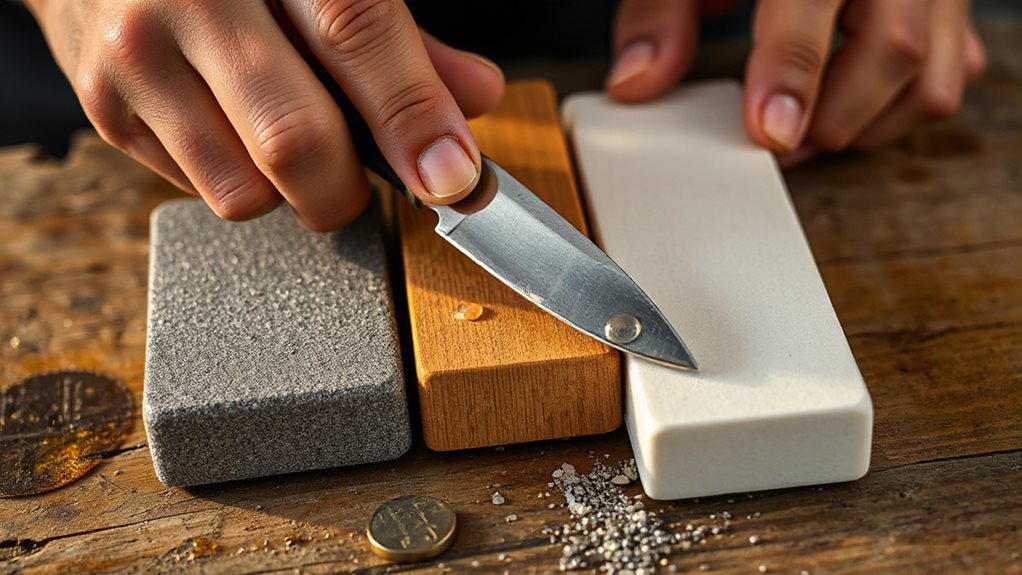
Most often, refining your pocket knife’s edge comes down to one key principle: gradually stepping up through finer grits to replace coarse scratches with increasingly subtle ones.
Start at the finest grit that removes the previous marks, then move up—300, 600, 1000, 6000—with lighter pressure each time. Alternate strokes, check for disappearing striations, and strop at the end to polish the edge and remove the wire burr.
Detect and Remove the Burr
You’ve worked your way through progressively finer stones, each pass refining the edge and smoothing out the deeper scratches left behind—now it’s time to focus on one of the most telling signs that your sharpening is on track: the burr.
Run your finger perpendicular to the edge, feel for roughness, or use a fingernail test—catches mean it’s still there.
Check with paper cuts or magnification, especially on hard steels.
Once detected, weaken the burr with light edge-trailing strokes, then remove it using short, light edge-leading passes on each side.
Alternate evenly, keep the angle consistent, and avoid blade flex.
Finish with stropping on denim or a taped edge to polish and micro-convex the apex, ensuring a clean, sharp, and durable edge ready for real-world use.
Use a small amount of graphite lubrication on the strop to reduce friction and help pull off any remaining burrs.
Strop for a Razor-Sharp Edge
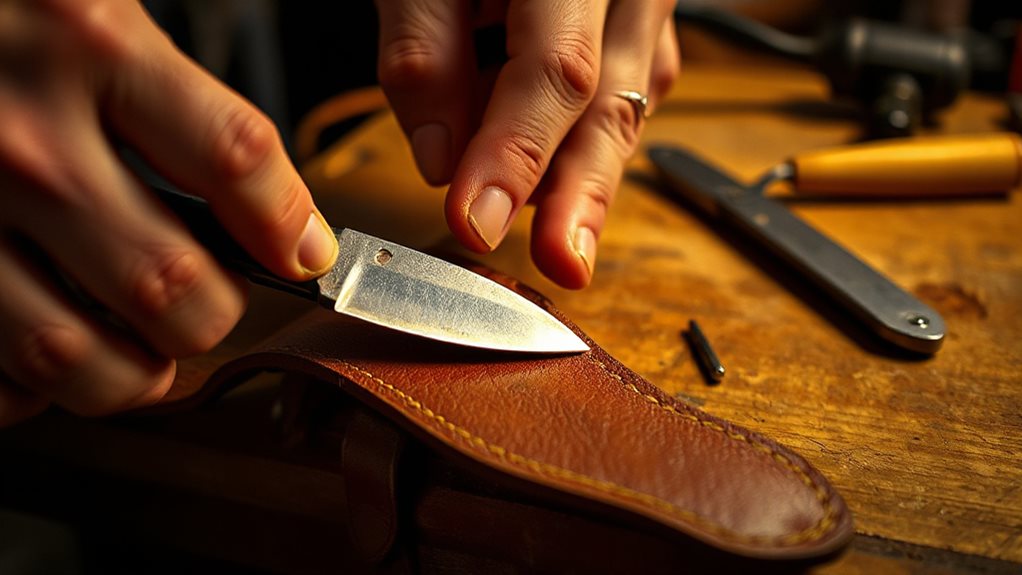
Often overlooked but always worth the effort, stropping brings your pocket knife’s edge to a refined, razor-sharp finish that cuts with precision and control.
Draw the blade backward across a leather strop at a 20-degree angle, using light pressure. Alternate sides, maintain a consistent angle, and repeat 15–20 times per side. Let the compound do the work—this final step guarantees peak sharpness and edge alignment.
Test and Maintain Your Sharp Pocket Knife
Now that your knife’s edge feels like silk through paper, it’s time to make sure it stays that way with regular testing and upkeep.
Check for smooth cutting performance weekly, wipe the blade after each use, and clean monthly—or more if you’re out in dust or rain.
Inspect for grit, lubricate the pivot with a drop, and store it dry.
Stay on top of maintenance, and your knife will stay sharp, safe, and ready whenever you are.
Keep a small, organized first aid kit nearby when using knives to handle any minor cuts immediately.
Final Note
You’ve got this—just keep your angle steady, move through the grits, and don’t skip stropping. You’ll feel the difference a sharp edge makes. Regular maintenance means less work later, so touch up your blade often. With the right tools and a little practice, you’ll keep your pocket knife ready for anything. Stay consistent, stay safe, and enjoy the confidence that comes with a clean, sharp cut every time.


