
Fish spawn through a fascinating process where females release eggs while males discharge sperm (called milt) to fertilize them externally in the water. You’ll find that most species respond to environmental triggers like water temperature and seasonal changes to time their spawning. During this process, fish may build nests, defend territories, and exhibit specific behaviors to protect their offspring. Understanding these complex spawning patterns reveals nature’s extraordinary reproductive strategies.
TLDR
- Female fish release eggs while males release sperm into the water, where external fertilization occurs to create fertilized eggs.
- Most fish spawn in response to environmental triggers like water temperature changes, seasonal shifts, and lunar phases.
- Some species build and defend nests in specific locations, while others release eggs directly into open water.
- Fish lay hundreds to thousands of eggs, though survival rates in the wild are typically low at around 15%.
- After fertilization, eggs develop into yolk-sac larvae, then into fry, and finally mature into reproductive adults.
The Basics of Fish Spawning

Fish reproduction is a fascinating process that primarily occurs through spawning, where females release eggs that are then fertilized by males.
During this process, females can produce hundreds to thousands of eggs, and timing is essential. You’ll find that most fish species choose specific seasons to spawn, responding to environmental triggers like water temperature and daylight hours to guarantee ideal conditions for their offspring’s survival. This spawning behavior varies significantly between different species, making each fish type unique in its reproductive approach. Additionally, the competitive nature of fishing can be influenced by understanding fish spawning patterns, which can significantly affect fishing success during specific seasons.
External Vs Internal Fertilization Methods
Understanding the methods of fertilization in aquatic life reveals two distinct approaches: external and internal fertilization.
Most fish use external fertilization, releasing eggs and sperm into the water where they mix and fertilize. This process is often triggered by water temperature changes that signal optimal spawning conditions. In fact, some species, such as salmon and trout, engage in seasonal migrations to specific spawning grounds to enhance reproductive success.
However, some species, like certain sharks, have evolved internal fertilization, where fertilization occurs inside the female’s body, offering better protection for developing embryos.
Environmental Triggers for Spawning
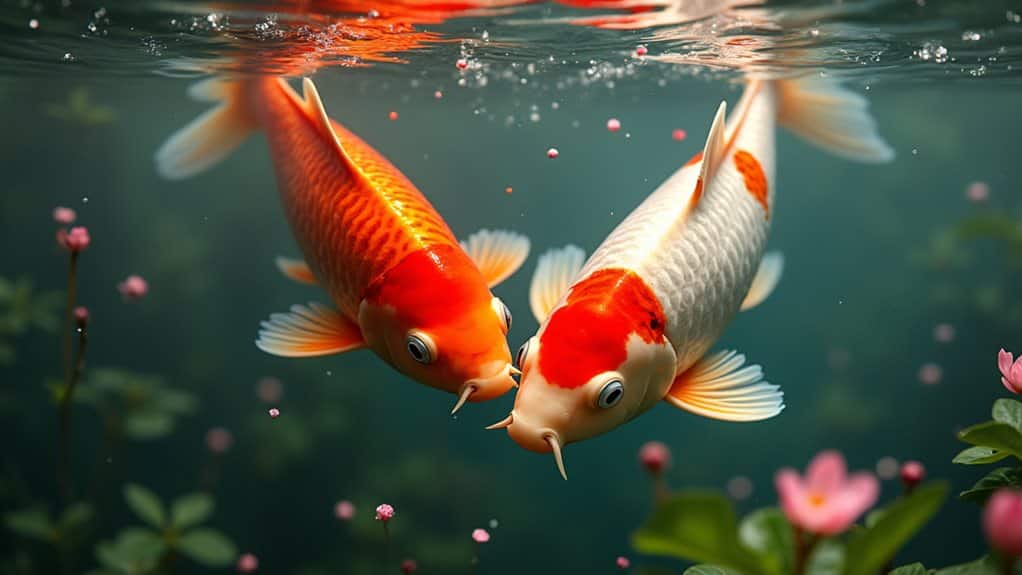
Water temperature and seasonal changes play a vital role in triggering fish spawning, as you’ll find most species respond to warming waters and longer daylight hours that signal best breeding conditions.
You’ll notice that many fish species also time their spawning activities according to lunar phases, particularly during full or new moons when tidal forces are strongest.
These environmental cues work together with tidal cycles to create perfect conditions for egg release and fertilization, ensuring the best possible chance for reproductive success. Additionally, understanding tidal cycles can further enhance predictions for spawning times among various fish species.
Temperature and Seasonal Changes
Throughout the natural world, temperature and seasonal changes serve as essential triggers that prompt fish to begin their spawning cycles.
You’ll find that most fish species respond to specific temperature ranges, with some spawning between 55-80°F.
As daylight hours increase and waters warm, these environmental cues trigger hormonal changes in fish, leading them to seek out suitable spawning grounds.
Lunar and Tidal Effects
Natural cycles in our oceans and seas play a fascinating role in fish reproduction, with lunar phases and tidal patterns serving as essential triggers for spawning behavior.
During full and new moons, you’ll find many species taking advantage of stronger tidal flows to disperse their eggs and larvae.
Fish like Pacific herring specifically choose neap tides after new moons for ideal spawning conditions.
Types of Spawning Behaviors
Fish employ two primary methods of reproduction: external fertilization, where eggs and sperm are released into the water, and internal fertilization, where fertilization occurs inside the female’s body.
You’ll find that many species engage in elaborate nest-building behaviors, with males often constructing and defending specific sites for egg deposition.
While some fish simply scatter their eggs and move on, others, like cichlids and sticklebacks, display extraordinary parental care by guarding their eggs and fry against predators until they’re able to survive on their own. Additionally, the process of spawning can be influenced by environmental factors, including water temperature and quality, which play a crucial role in the reproductive success of many fish species.
External Vs Internal Fertilization
When it comes to reproduction in aquatic environments, you’ll find two primary methods of fertilization among fish species: external and internal.
In external fertilization, males and females release their gametes into the water simultaneously, while internal fertilization occurs inside the female’s body.
Most fish use external fertilization, though some species, like sharks and rays, fertilize internally for better survival rates.
Nest Building and Guarding
Among the most fascinating aspects of fish reproduction, nest building and guarding behaviors represent essential survival strategies that many species have evolved to protect their offspring.
You’ll find males constructing saucer-shaped depressions in shallow waters, where they’ll fan away silt and defend the area from predators.
After spawning, they’ll continue guarding the eggs and fry while maintaining oxygen levels through constant fanning movements.
Nest Building and Territory Selection

Throughout the animal kingdom, nest building and territory selection represent critical aspects of fish reproduction, with many species demonstrating extraordinary design and defensive abilities.
You’ll find that fish, particularly bass and sunfish, carefully choose locations with gravelly or sandy substrates in varying water depths.
These spots must provide both stability for the nest and protection from predators while allowing males to effectively guard their eggs.
Timing and Seasonal Patterns
Fish spawning follows predictable seasonal cycles that you’ll notice throughout the year, with most species choosing to reproduce during spring and early summer when conditions are ideal.
You’ll find that environmental triggers like water temperature and increasing daylight hours play vital roles in determining exactly when fish begin their reproductive activities.
Different species have evolved to spawn at specific temperature ranges – for instance, walleyes prefer cooler waters in the 30s to 40s Fahrenheit, while bluegills won’t start until the water reaches about 70 degrees Fahrenheit.
Spawning Cycles By Season
While nature follows predictable patterns, different fish species have evolved to spawn during specific seasons that offer the best conditions for their offspring’s survival.
You’ll find most freshwater fish spawning in spring’s warming waters, while salmon species vary greatly, with some running in summer, others in fall, and winter-run varieties completing nature’s year-round spawning cycle.
Environmental Triggers For Reproduction
When environmental conditions align perfectly, nature orchestrates an intricate harmony of triggers that signal fish to begin their reproductive cycles.
Temperature acts as a primary trigger, regulating steroidogenesis and gametogenesis, while changes in day length (photoperiod) influence spawning timing.
You’ll find that rainfall and salinity changes also play essential roles, especially in tropical species’ reproductive patterns.
Parental Care Strategies

Throughout the animal kingdom, parental care strategies in fish stand out as particularly captivating, with males taking the primary caregiving role in roughly one-third to half of all species.
You’ll find that these fathers engage in essential behaviors like nest building, egg protection, and oxygen provision.
Notably, this care doesn’t just benefit offspring – it actually makes males more attractive to females.
From Egg to Adult: Development Stages
Building on the extraordinary parental care strategies in fish, let’s investigate the enthralling voyage from egg to adult.
Fish development follows distinct stages, starting as fertilized eggs that hatch into yolk-sac larvae.
These larvae then develop into fry, which actively feed and seek shelter.
As juveniles, they’ll develop adult-like features before finally maturing into reproductive adults ready to spawn.
Different Spawning Strategies Across Species

As fish species have evolved across millions of years, they’ve developed a fascinating array of spawning strategies to guarantee their offspring’s survival.
You’ll find broadcast spawners like tuna that release eggs into open water, benthic spawners that deposit eggs on the seafloor, and species that demonstrate complex parental care, such as cichlids that protect their young until they’re ready to swim independently.
The Role of Water Quality in Spawning
When fish prepare to spawn, water quality plays a critical role in determining their reproductive success.
You’ll find that key factors like temperature, pH levels, and dissolved oxygen must be just right for eggs to develop properly.
Poor water conditions from pollution, agricultural runoff, or climate change can seriously impact spawning rates and even threaten entire fish populations.
Survival Rates and Natural Selection

Despite fish producing thousands of eggs during spawning, their survival rates through various life stages tell a fascinating story of nature’s selective process.
Only about 15% of wild salmon eggs survive to become alevins, while those with better genetic adaptations for predator avoidance and environmental resilience have higher chances of reaching adulthood.
In hatcheries, controlled conditions can enhance survival rates to 90%.
Final Note
You’ve now learned about the fascinating world of fish reproduction, from the basic mechanics of spawning to the complex environmental factors that trigger it. Understanding these processes isn’t just interesting – it’s vital for conservation efforts and maintaining healthy aquatic ecosystems. Whether you’re an aquarium enthusiast or simply curious about marine life, you’ll appreciate how different species have evolved diverse strategies to guarantee their survival through successful spawning.


